Showing posts with label John Adams. Show all posts

Friday, January 09, 2026

Amplification


Shotgun Players
Illustration for Sunday in the Park with George


I saw two shows by Stephen Sondheim and James Lapine recently, Sunday in the Park with George at Shotgun Players and Into the Woods at the San Francisco Playhouse, and had rather different reactions to them.

I had never seen Sunday in the Park — I managed to miss several local productions over the years — and hadn't heard the score. It's true that I have the two Hat books and I could have, should have, taken the time to read the lyrics, even though the books are awkward to read from. I don't have a recording of the songs.

I did not particularly connect with the story or the score. No shade on the performers, who sang and acted well, but the music made little impression on me and unfortunately, the amplification didn't balance the tiny orchestra and the singers correctly. The instruments were simply too loud, and I could only make out about half the words. That is a big problem with any English-language score, and, well, it's Stephen Sondheim and you really want and need to be able to discern what the heck everyone is singing about. 

I'd like to see it again, under different conditions: better musical balances and also...I don't feel that the tiny stage at Shotgun's theater serves this work well. The painting - A Sunday on La Grande Jatte — is quite large and the musical built around it needs some room to spread out. Shotgun's run of the show has been extended to February 15 (!), so if you'd like to see it, there are very likely tickets available.

Into the Woods landed rather differently. I had a slight familiarity with the show and the songs, because long ago I'd seen the film version of it. Regardless, a wonderful cast, Susi Damilano's superb direction, a charming unit set, and, well, everything, made it a thoroughly delightful evening. I particularly loved the stabby Little Red Riding Hood.

In this production, the amplification works much, much better than that for Sunday in the Park. The balances are correct: the tiny pit band is audible, but they never, ever, drown out the singers, whose enunciation is excellent. I probably caught 90-95% of the words. (The production runs through January 17.)

A few weeks ago, when Joshua Kosman discussed Sondheim, the recently-deceased Tom Stoppard, and Into the Woods on his Substack, composer Gabriel Kahane, whose work I like a whole lot and have reviewed very positively, chimed in to say he was not much of a fan of Sondheim's music, that he'd read the Hat books and gotten a lot out of that, but then he'd gone to see Into the Woods and found the songs musically undistinguished.

After seeing the show, I sort of get where he is coming from: I think that he is hearing a certain homogeneity across the songs in the show that can certainly be heard as melodic and rhythmic tics. But here's the thing: the other Sondheim shows I know at all well, A Little Night Music and Sweeney Todd, are musically nothing like Into the Woods. I know Night Music very well, because long ago I played flute in the pit band for a local theater production in Bergen County, NJ. Its special trick is, as Joshua Kosman points out, a profusion of what sounds like to the casual ear like waltz time. The melodies aren't at all alike. From this, I'm sure that whatever Sondheim is doing in Into the Woods, it's all deliberate and thought out carefully.

Getting back to the matter of amplification and sound design, I inevitably find myself asking "But why are you amplifying your singers?" After all, the stage bands are tiny and so are the theaters. Wikipedia says that the Ashby Stage seats 119 people, while the San Francisco Playhouse seats 199.

People, those are tiny theaters and the actors cast in these shows know how to sing! What, exactly, is gained through amplification?

Years ago, when Sweeney Todd toured to San Francisco and played in a substantially larger theater — this was the production where the actors also played the instruments —I actually asked about it. I was told, I believe, that they wanted all audience members to have the same auditory experience, regardless of the venue. 

I think that my reaction to this was something like: But this is live theater. Where you sit does make a difference. That's a feature, not a bug. I guess that with amplification and its flattening effects everywhere, producers and audiences have come to expect that everything will sound the same, like you're listening to a recording.

And this brings me to something I read in the New York Times a few days ago, a profile by Joshua Barone of Beth Morrison, who has, over the last 20 years, become an extremely important producer/impressario of new operas, through her Beth Morrison Projects. She can put together a composer and librettist, help cast an opera, find venues. She has become indispensable to producing new opera outside operas commissioned directly by opera houses. 

Morrison says that she has “very strong opinions on the kind of art [she wants] to make,” then she's quoted later in the piece saying this:

Critics have also taken issue with Morrison’s insistence on amplification, especially in black box theaters. But, Morrison said, Wagner probably would have done the same thing. He wanted to use every tool at his disposal, and she aims, with each show, for “a theatrical sound installation.”

“Many companies will not do this, and that’s fine,” she added. “But that’s not the world that I want to live in. I profoundly believe that putting a microphone on an opera singer completely changes their ability to act.”

Let me say that if composers choose to amplify their works, sure, fine, it's their decision to make use of, as Morrison says, that particular tool. They know what they want in the way of vocal style in their works, for whatever reason: they prefer the sound of an amplified voice, they're concerned about how to orchestrate to allow an unamplified voice to be heard, they don't like the sound of the unamplified operatic voice, they're worried about whether the singers can put across the words. Amplification can be done well (for John Adams's operas, sound design by Mark Grey) or badly (San Francisco Opera's Sweeney Todd, speaking of Sondheim, and Show Boat).

These are complicated problems and composers have chosen a range of solutions in traditionally-sung opera. Singers are affected not only by orchestration, but by the size and acoustics of a venue, the language in which a libretto is written, the composer's musical style, the singability of the libretto, and how the composer sets the words. 

However, I'd really like to hear a lot more about Morrison's contention that "putting a microphone on an opera singer completely changes their ability to act." For one thing, my understanding is that microphone singing requires a wholly different technique from traditional operatic singing; I remember a singer I know commenting about this, when they started working with an ensemble that used amplification. 

For another, I've seen many opera performances, some amplified, most not, of works written between 1607 and now, with a wide range of performers. A lot of them were great actors, and it's really hard for me to accept that their acting abilities would be "completely changed" (implied: improved) if they were amplified. Their acting depends at least as much on what the composer and librettist give the singers and, ah, how good the director is as on whether they're amplified, and, well, I would say a lot more.

Not that it's very possible to even run an experiment. Could you get the same cast to perform La Traviata with and without amplification? Can you get the same cast to perform Nixon in China with and (clandestinely) without amplification? It certainly would be interesting.

Let's move on to Morrison's contention that Wagner probably would have done the same thing, that is, used amplification.

I consider it intellectually risky to try to ascribe theoretical actions to long-dead people. You know, Bach would surely have written for the piano if it had existed in his time; Chopin and Beethoven surely would have loved the modern 9-foot concert grand, etc. Composers will use the tools of their time, and I'm going to say that my guess is that the music they wrote would have been different if they'd had different instruments available! Beethoven and Chopin both wrote peddling effects and articulations that are easier to achieve on a lightweight fortepiano than on a modern concert grand. We might guess, but we cannot know, what they would have composed if suddenly a 1930 Steinway had appeared in their studios.

There is one exception that a friend mentioned to me when I quoted Morrison to him: that passage in Beethoven's Fifth Symphony, first movement, where the bassoons play a phrase that is elsewhere given to the horns. That's because the natural horn of his day couldn't play that phrase in every key Beethoven needed for the movement. These days, we have valve horns, and that passage, which sounds faintly absurd in the bassoons, is generally assigned to the horns. 

But we do know something about what Wagner might have done about issues of singer audibility, because he actually did it: he built the Bayreuth Festspielhaus, which is laid out like an amphitheater, rather than in tiers like most opera houses, and in which he put the orchestra on descending risers under the stage. The Bayreuth sound is unique and magnificent, and singers don't have to force or press or have enormous voices (as opposed to normally large operatic voices) to be heard. This is one thing we do not have to guess or make hard-to-support conjectures about.

Wednesday, January 22, 2025

Adams and (Shudder) Orff at SFS


David Robertson, John Adams, and Víkingur Ólafsson
Davies Symphony Hall
January 16, 2025
Photo: Brandon Patoc, courtesy of San Francisco Symphony


I reviewed San Francisco Symphony, with David Robertson conducting, in the world premiere of John Adams's beautiful new piano concerto, After the Fall, and Carl Orff's Carmina Burana. Yes, believe me, I had questions about the pairing, which I suppose I could have directed to SFS, but I had no particular hope of getting an honest answer about this pairing. When you've got David Robertson on board, why would you program Carmina to go with an Adams premiere? This was the ninth Adams premiere that SFS has performed and I'd be surprised if they haven't performed all of his major works. The last big local premiere was Must the Devil Have All the Good Tunes?, with Ólafsson and Esa-Pekka Salonen. Were there a lot of empty seats? I do recall a number of performances in 2021-22 and since then with shockingly low attendence.

I did discover that it wasn't the first time Robertson conducted the thing with SFS. I wasn't at that performance, because singing Carmina once, when I was in graduate school, and hearing an amateur chorus sing it once, were more than enough for me. It is admittedly much more impressive with the 125-voice SF Symphony Chorus and SFS itself than when performed with two pianos and percussion, but "impressive" is not the same as "good." Robertson is a terrific conductor and I'm sure that he made Carmina sound about as good as it can sound, but hey - he's done great Messiaen and great Carter here, so why ask him to do Carmina again?

Media round-up (updated on 1/23 to include Gabe Meline's review):

  • Joshua Kosman, On a Pacific Aisle, writes beautifully about After the Fall and then savages the Orff. He calls the Adams "spectacularly beautiful and ingratiating," then goes on to question the programming decision that put Carmina on the same program. In addition, he says that "Carmina burana taints everything it touches. It’s a ghastly piece of music — repetitive, simple-minded, and resolutely scornful of anything approaching harmonic or contrapuntal substance. We could bring in the piece’s other sins as well, including its fraught history with the Nazi regime and its pilferings from Stravinsky’s Les Noces." 100%, as they say on social media.
  • Lisa Hirsch, SFCV and SF Chronicle. Note that I could not squeeze in that the harp parts look beautiful, but I could not hear them very well from my seats at the dress rehearsal and first performance. A friend seated closer and in the center of Davies reports that she could hear them loud and clear at the Saturday performance.
  • Michael Strickland, SF Civic Center
  • Stephen Smoliar, The Rehearsal Studio. "After the Fall came across as little more than a weak shadow of what Adams had been doing some forty-odd years ago."
  • DB at Kalimac's Corner. "Led by guest conductor David Robertson, this was a pretty dull run-through if you've heard Carmina as often as I have." And he liked After the Fall better than Must the Devil Have all the Good Tunes?
  • Gabe Meline, KQED. On the Adams: "After opening with cascading notes on harp and celeste reminiscent of Bernard Herrmann’s Vertigo score, Thursday’s world premiere at Davies Symphony Hall of After the Fall presented blissful, clustered melodies on the piano, and the type of sharp jabs that Ellington once delivered on his piano from the brass and woodwinds." On Carmina: "People either love or hate Carl Orff’s Carmina Burana. I am in the latter camp, but had never before heard it live. It was performed very well, and I now dislike it more."
  • Opera Tattler. "The music swirled and buzzed, and I had the very weird sensation of pinpricks in my ribcage from the various sounds."
  • Previously: Media round-up for Must the Devil Have All the Good Tunes?
On Blue Sky Social, Michael Good had the following to say:

Here's my take on Carmina Burana, in stark contrast to @joshuakosman.bsky.social and @lisairontongue.bsky.social. It's a visionary piece that anticipates rock and roll by nearly 20 years. It elevates rhythm, melody, lyrics, and repetition over harmonic complexity. Its popularity is well deserved.

If what we're looking for is elevating rhythm, melody, lyrics, and repetition over harmonic complexity, let me mention the works of one Igor Stravinsky, who did all of that between 1913 and 1923, long before Orff, in Le Sacre du Printemps and Les Noces, and, not incidentally, did it all much, much better than Orff. Okay, Stravinsky is much more harmonically complex than Orff, but I'm sure you get the point I'm making here.


Thursday, March 02, 2023

Stuff I Expect to See in SF

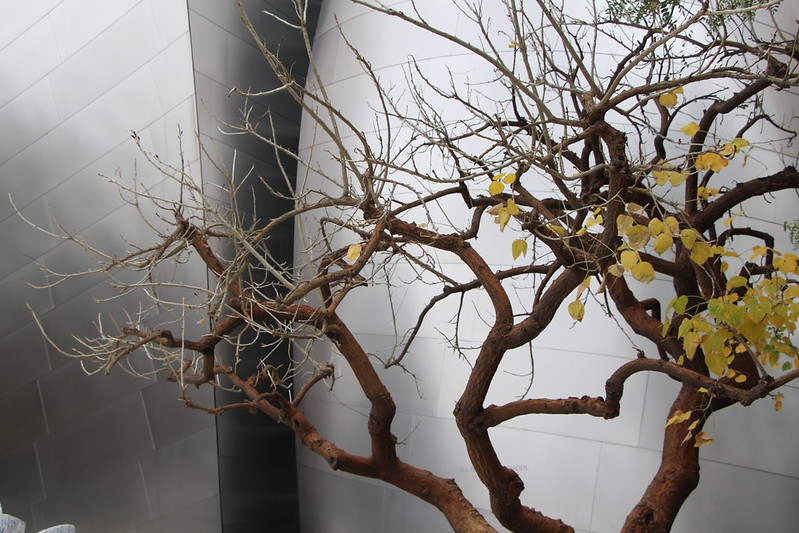
Photo take on a misty day of a bare tree against an abstract, silvery building

Walt Disney Concert Hall Garden
March, 2017
Photo by Lisa Hirsch

Between this year's and next year's goings-on at the LA Phil, I would bet a few bucks that we will be seeing works or programs like these in San Francisco sooner or later:

  • Felipe Lara, Double Concerto for Flute and Bass, because Susanna Mälkki is conducting it with SFS Collaborative Partners Claire Chase and esperanza spaulding.
  • Bryce Dessner, Double Concert for Two Pianos, because the composer is a Collaborative Partner
  • Esa-Pekka Salonen, Fanfare, which apparently features Collaborative Partner Pekka Kuuisisto
  • Nico Muhly, Shrink by another Collaborative Partner
  • Esa-Pekka Salonen, Karawane
  • Herbert Blomstedt conducts Schubert 6 and Beethoven 7
  • Esa-Pekka Salonen conducts the Sibelius violin concerto (Lisa Batiashvili) and John Adams Naive and Sentimental Music....with the San Francisco Symphony, on a weird one-day runout to Los Angeles.
  • MTT conducts Tchaikowski 5 and Stravinsky Petroushka
Also guessing that there's a Ring revival coming at the Paris Opera because Gustavo Dudamel is conducting a well-cast semi-staged Das Rheingold in January, 2024. It's part of the orchestra's celebration of Frank Gehry, architect of Walt Disney Concert Hall, and he's the scenic designer.

And the SFS program feature about Gabriella Smith discloses that "The Symphony will present Breathing Forests [Smith's organ concerto] next season as part of the California Festival: A Celebration of New Music."

Monday, September 19, 2022

Antony and Cleopatra: Media Round-Up


Amina Edris and Gerald Finley in the title roles of Antony and Cleopatra.
Act 2, before the Battle of Actium
Photo: Cory Weaver / San Francisco Opera


John Adams's new opera, Antony and Cleopatra, opened the other day, and the reviews are rolling in. I expect this list to grow. Paywalls in many of these places.
Related: When the Star Cancels, Opera History is Made, by Lisa Hirsch; A Study of Power, by Angela Allen, Oregon Artswatch

Wednesday, August 31, 2022

Antony and Cleopatra: Pre-Performance Media Roundup

Photo of director Elkanah Pulitzer, composer John Adams, and SFO General Director Matthew Shilvock, masked, in the Atrium Theater

Director Elkhanah Pulitzer, Composer John Adams, and 
SFO General Director Matthew Shilvock
Atrium Theater, SF
Rehearsal for Antony & Cleopatra
Photo by Kristen Loken, care of San Francisco Opera

All sorts of articles and other items on the Web related to the premiere of John Adams's latest, Antony and Cleopatra, at San Francisco Opera.

Watch this space; I expect to add to the list above between now and September 10, when Antony opens. I'm reviewing for SFCV, and of course I will have a media round-up after that.

Must mention that a rehearsal photo published on Facebook by Matthew Shilvock revealed two harps, a celesta, and a cimbolom in the orchestra. He must have taken the photo from the lighting catwalk in the Atrium Theater.

Monday, June 27, 2022

Adams, Stucky, and Sibelius at San Francisco Symphony

Photo of a man in a blue suit playing a grand piano with a woman in black wearing white glasses seated to his left.

Pianist Víkingur Ólafsson performs John Adams’ Must the Devil Have All the Good Tunes? with Music Director Esa-Pekka Salonen leading the San Francisco Symphony, June 23, 2022.

If you take a look at the photo above, you'll see a woman seated to the left of and behind Víkingur Ólafsson. She's the page turner. He's playing from a tablet of some kind and she's turning pages with a Bluetooth or other wireless device.

There was a cute incident before the concerto. Alexander Barantschik, the concertmaster, stood up to tune the orchestra, and she hit an A on the piano. However....it was the A below middle C, which is the wrong octave for tuning. The correct pitch is A above middle C, which is in the oboe's range. When there's a piano concerto, whoever is playing principal oboe picks up the C from the piano for the winds, then the concertmaster. picks up the C from oboe for the strings.

When the page turner hit the wrong note, Barantschik looked shocked, stood up very straight, and with a sly smile hit the right A. He smiled, she smiled, everybody laughed.

Anyway, it was one hell of a performance, and the pianist has a new fan. I would have gone back for a second performance if SF Civic Center weren't completely impassible on Pride Weekend.

Here's a pop quiz: which reviewer wrote "In the transition to the second movement, one minute you think you’re in a roaring bar; a minute later you notice that somehow you have relocated to a quiet, darkened lounge" and which one wrote "The slow movement, at its heart, is like a cocktail-lounge take on Ravel, turning its harmonies this way and that, and catching reflections of light from a mirror ball"? Both also used "tender" to describe the Sibelius. Reviewers do not read each other's reviews before filing their own.

I had a bit more to say about Radical Light because I reviewed its world premiere in 2007. It's a wonderful piece and I'm so glad to have heard it again.


Monday, May 23, 2022

News of the Day, Julia Bullock Edition; Media Round-up of History's Persistent Voice


History's Persistent Voice
Julia Bullock, seated left; Christian Reif, conducting
Photo courtesy of San Francisco Symphony, (c) Kristen Loken

On Tuesday, the soprano Julia Bullock gave a remarkable performance in History's Persistent Voice, a concert of works by Black women composers interspersed with readings from incarcerated people, quilters, and artists. This is a fabulous program, created by Bullock; all of the works were written for her and she make substantive contributions to each, as an editor or curator of the texts. I hope that it will appear on CD or DVD; it's a marvelous program in every way and I would love to see it again.

Reviews here:
And today came the announcement of something I had been wondering about: Bullock has withdrawn from the world premiere performances of John Adams's new opera, Antony & Cleopatra, which will open San Francisco Opera's centennial season in September. You can't tell from the photo above, but Bullock was wearing a jacket with a slight flare at the hips, and, well, I did notice. I especially noticed when she remarked that "...motherhood is on my mind a lot these days." I made some inquiries immediately after the program, putting a member of the SFO publicity department on the spot with questions that the company wasn't ready to answer yet. (Joshua Kosman caught that comment, as did Janos Gereben, so I guess we were all waiting for the shoe to drop. Christine Goerke made her SFO debut while visibly pregnant, but not everyone is in a position to do that!)

Big sigh, but after reading the SFS press release, it does appear that she will be in future bring-ups of the opera, which is co-commissioned by Barcelona’s Liceu Opera, Palermo’s Teatro Massimo, and the Metropolitan Opera. 

Best wishes to Amina Edris, a lovely singer, for a great success as Cleopatra!

Here's most of the press release:

SAN FRANCISCO OPERA ANNOUNCES CASTING UPDATE FOR

WORLD PREMIERE OF JOHN ADAMS’ ANTONY AND CLEOPATRA,

OPENING SEPTEMBER 10


Amina Edris to Perform Cleopatra, Replacing Julia Bullock


San Francisco Opera today announced a cast change for the world premiere of John Adams’ Antony and Cleopatra, opening on September 10, 2022 as the first operatic presentation of the Company’s 2022–23 Centennial Season.


Soprano Amina Edris will create the role of Cleopatra, replacing Julia Bullock, who has withdrawn from the production. Bullock and her husband, conductor Christian Reif, are expecting the birth of their first child this fall. While Bullock will not debut the role in San Francisco, she remains connected with the project for future engagements.


San Francisco Opera Tad and Dianne Taube General Director Matthew Shilvock said: “Julia has been such an inspiration in the creation of John Adams’ Antony and Cleopatra and we will miss her dearly from the premiere, but it is for the happiest of reasons imaginable! We wish Julia and Christian great joy as they begin a family together. We are so grateful to Amina for joining us to create this extraordinary role and excited for the depth of character and beautiful artistry she will bring to Cleopatra. Amina is having such success around the world, and we’re thrilled to welcome her back to San Francisco Opera to help us launch our second century in such a special way.”


Julia Bullock said, “I am deeply grateful to Matthew and San Francisco Opera for being so respectful and supportive as I came to the decision to withdraw from the premiere to prepare for the birth of our first child. Amina will be thrilling in the role of Cleopatra, and I wish the entire cast and crew my very best as they bring this new work to life.”


Born in Egypt and raised in New Zealand, soprano Amina Edris is rapidly establishing herself as one of the most exciting young stars on today’s operatic stage. Following post-graduate studies at the San Francisco Conservatory of Music, Edris participated in the Merola Opera Program (2015) and Adler Fellowship Program (2016, 2017). As a San Francisco Opera Adler Fellow, she performed roles in CarmenDream of the Red ChamberRigolettoElektra and La Traviata on the War Memorial Opera House stage. In 2019 she returned to the Company, starring as Juliette in Gounod’s Roméo et Juliette, opposite the Roméo of her husband, tenor Pene Pati.


Edris made her Canadian Opera Company debut last month as Violetta in a starry cast for Verdi’s La Traviata and her performance was hailed as “beautiful of tone throughout her registers, with accurate coloratura and no shortage of power” and “the revelation of the night” (Bachtrack). She has performed Manon in Massenet’s opera to widespread acclaim at Opéra National de Bordeaux and Opéra National de Paris where Opera Forum said of her interpretation: “Amina Edris literally brought the Opéra Bastille to its knees with her superlative incarnation of the title role, both vocally and theatrically.” Recent appearances include Alice in Meyerbeer’s Robert le Diable at Bordeaux, Micaëla in Carmen at Opéra du Rhin, Violetta for Opéra de Limoges. This summer, she returns to Europe for engagements with the Paris Opéra as La Folie in Rameau’s Platée and Festival d’Aix-en-Provence as Adalgisa in Bellini’s Norma. Next spring, she makes her house debut at Barcelona’s Gran Theatre del Liceu as Manon.


Edris is a featured artist in San Francisco Opera’s 2022 Webby People’s Voice award-winning video portrait series, In Song. Filmed on location in her native Cairo, In Song: Amina Edris follows the soprano’s journey from a childhood infused with Arabic music to her emergence as an operatic soprano. The free, 19-minute episode showcases Edris performing the song “Ghanili Shway Shway,” first performed by iconic Egyptian singer Oum Kalthoum, and the French art song “Adieux de l’hôtesse arabe” by Carmen composer Georges Bizet.


Edris joins a notable Antony and Cleopatra cast for San Francisco Opera. Bass-baritone Gerald Finley, an acclaimed Adams role creator for his performances as J. Robert Oppenheimer in Doctor Atomic, is the Roman general and triumvir, Antony. Tenor Paul Appleby, who created the role of Joe Cannon in the Company’s 2017 premiere of Adams’ Girls of the Golden West, is the young Caesar, Octavius. Bass-baritone Alfred Walker is Antony’s confidante Enobarbus and mezzo-soprano Elizabeth DeShong portrays Octavia, Caesar’s sister and the wife of Antony. San Francisco Opera Music Director Eun Sun Kimopens the 100th season with this highly anticipated world premiere by the distinguished composer and Bay Area resident.


Created for San Francisco Opera’s centennial, Antony and Cleopatra is a co-commission and co-production with Barcelona’s Liceu Opera, Palermo’s Teatro Massimo and the Metropolitan Opera. With a libretto adapted from Shakespeare’s tragedy with supplementary passages drawn from Plutarch, Virgil and other classical texts, Adams, director Elkhanah Pulitzer and dramaturg Lucia Scheckner blend the mythic imagery of antiquity with the starry glamour of 1930s Hollywood. Pulitzer heads a production team of Tony Award-winning set designer and MacArthur Fellow Mimi Lien, costume designer Constance Hoffman, lighting designer David Finn, projection designer Bill Morrison and sound designer Mark Grey.

Wednesday, January 19, 2022

SFO 100


War Memorial Opera House
Photo by Lisa Hirsch

It's finally here: the San Francisco Opera centennial season announcement. It's kind of a wow! And that's even though it's a shorter season than I would like; I'm somewhat surprised that with all of the hoopla and fundraising attendant on such an occasion, the company couldn't get donors to pony up enough money for 10 operas. 

To my surprise, the announcement includes part of the 2023-24 season, and that looks like it'll be a good one as well, because it's got three new operas on it.

Here are the answers to the quiz that Matthew Shilvock set up, with as much detail as I can reasonably fit in a bullet list:
  • Two new operas by Bay Area composers
    • John Adams, Antony and Cleopatra, libretto put together by the composer largely from the Shakespeare play, but with additional texts from other sources. Julia Bullock and Gerard Finley as the title characters; also starring Paul Appleby, Alfred Walker, Elizabeth DeShong; directed by Elkhanah Pulitzer. This will be the opening night performance, which I have some doubts about, because having an offbeat work didn't work so well back in the Rosenberg era when one of her seasons opened with The Mother of Us All. Music Director Eun Sun Kim conducts. (Right now I'm thinking that I should try to find a commercial recording or bootleg of the Barber Antony that opened the Metropolitan Opera House at Lincoln Center.)
    • Gabriela Lena Frank, El úlitmo sueño de Frida y Diego, libretto by Nilo Cruz. Co-commission; first performances are at San Diego Opera in October, 2022. Starring Daniela Mack (Frida), Alfredo Daza (Diego), Yaritza Vélez, and Jacob Ingbar star. Roberto Kalb conducts, Lorena Maza directs. SFO has made a great effort here to cast this with native Spanish speakers from the Americas! I think that this is the first main-stage work composed by a woman and the first work in Spanish to be presented by SFO. She is also Jewish, but there's Meyerbeer in the company's past, so she's definitely not the first Jewish composer to have a work in the repertory here.(Whatever happened to those rumors about Florencia en el Amazonas?) 
  • Two new productions from the core repertory
    • Madama Butterfly, co-production with The Tokyo Nikikai Opera Foundation, the Semperoper Dresden and The Royal Danish Opera. There is a concept, which is seeing the opera through the eyes of Dolor, Cio-Cio-San and Pinkerton's son. Directed by Amon Miyamoto  and starring Karah Son and Michael Fabiano. Hyona Kim is Suzuki and Lucas Meachem is Sharpless. Eun Sun Kim conducts. There's an effort here not to engage in yellow face, which is good. There's also a statement about this opera and Asian Opera Alliance. Note the work being done at Boston Lyric Opera's Butterfly Project discussion series, which seems like the kind of thing SFO could do.
    • La Traviata (finally, the 35-year-old Copley production is being replaced). Pretty Yende (Violetta), Jonathan Tetelman (Alfredo), Simone Piazzola (Germont). Shawna Lucey directs, Eun Sun Kim conducts.
  • Two operas that had their US premieres here. YES, these are what I'd hoped for!
    • Die Frau ohne Schatten, R. Strauss, in the David Hockney production. Conducted by Sir Donald Runnicles, of course; with Nina Stemme (Dyer's Wife), Camilla Nylund (Empress), Linda Watson (the Nurse), Johan Reuter (Barak), and David Butt Philip as the Emperor. Nothing about the casting of the Spirit Messenger, Voice of the Falcon, Guardian of the Threshold of the Temple, the brothers, or any of the other gazillion roles in this gigantic work; presumably many of them will be drawn from the ranks of the 2023 Adler fellows because this is during the summer of 2023. Roy Rallo directs. 
    • Dialogs of the Carmelites, Poulenc, production by Olivier Py, from the Théâtre des Champs-Elysées. Heidi Stober as Blanche de la Force,  Michelle Bradley as Madame Lidoine, the new Prioress; Michaela Schuster (Madame de Croissy, the Old Prioress), Melody Moore as Mere Marie, Deanna Breiwick as Sister Constance. Ben Bliss returns as the Chevalier de la Force. Eun Sun Kim conducts. A great opera that hasn't been done here since 1982.
  • Two operas in styles not heard in a number of years 
    • Eugene Onegin, Tchaikovsky, Robert Carsen's production, which is supposed to be very beautiful. Evgenia Muraveva as Tatyana, Gordon Bintner as Onegin, Evan LeRoy Johnson (Lensky), Aigul Akhmetshina (Olga), Ferruccio Furlanetto (Prince Gremin). Vassilis Christopoulos conducts. in his American debut.
    • Orpheus and Eurydice, Gluck, new SFO production. This will be the third production of this opera that I've seen in the last several years.  Matthew Ozawa directs; his Fidelio was superb, so I have high hopes. Jakub Józef Orliński as Orpheus, Christina Gansch as Eurydice, Nicole Heaston as Amor. Peter Whelan from the Irish Baroque Orchestra and Ensemble Marsyas conducts.

The above are all productions new to San Francisco Opera.

For me, the biggest surprise in the above is that there's no production for Nicola Luisotti; I've assumed that there would be one for the former music director in this important season. Oh, well, maybe in 2023-24. But I do wonder whether either Traviata or Butterfly was originally intended for him.

Additionally, there's all of this happening:
  • Opening night concert and Opera Ball, September 9, 2022. Concert with Nadine Sierra, Michael Fabiano, Pene Pati, and Lucas Meachem. Eun Sun Kim conducts.
  • 100th Anniversary Concert, Friday, June 16, 2023. "A historic evening of music and memories." Eun Sun Kim conducts, details to follow.
  • Opera in the Park, Sunday, September 11, 2022 at 1:30 pm, Robin Williams Meadow, Golden Gate Park. Free.
  • Open House, Sunday, October 23, 2022. Tours and lots of family-friendly activities and demonstrations. Free.
  • Boheme Out of the Box, which will take a condensed La Boheme to SF communities.
  • Exhibitions of costumes and photos from the company's history.
Coming in 2023-24: three new operas, all SFO co-commissions, which is amazing for a company with an eight-opera season:
  • Mason Bates, The (R)evolution of Steve Jobs
  • Kaija Saariaho, Innocence
  • Rhiannon Giddens and Michael Abels' Omar
Other items of interest:
Do I have a regret or two about this season? Sure: there's no sign of Karita Mattila or Patricia Racette, both of whom have been stalwarts of the company for many years. (Or Ruth Ann Swenson, who is retired.) Philip Skinner, one of my favorite singers, has only a small role. I'd hoped that if SFO did Frau that it would cast Christine Goerke as the Dyer's Wife; she was wonderful at the Met in 2013. But it's a short season; there are many exciting debuts, and the company is definitely looking very much to the future in its casting.


Saturday, January 06, 2018

The Year in Review

This was one very weird year, in so many ways. Personally, it was pretty good! My job went reasonably well, and I have the best colleagues possible in Cloud Networking Docs and generally in Cloud Docs. The only task left with my mother's estate is filing one final tax return. I did not travel as much as I would have liked to, although....Los Angeles for opera; Seattle twice for work within a one month period; NY twice, once for my mom's unveiling, my aunt Ida's unveiling, and my uncle Irving's 99th birthday party, and, ten weeks later, Irv's funeral (sigh, but he had a good long run...); once to Hawaii (not the best vacation ever for various reasons); and once to Santa Fe for opera.

Musically, I will forever remember 2017 as the year Mason Bates wrote a better opera than John Adams. At no point before the dress rehearsal of Girls of the Golden West would I have expected this, and in fact, I would have laughed at the notion.

Boy, was I wrong. While my review of GGW was not as vitriolic as Joshua Kosman's, he and I and nearly everyone else are in agreement about the weaknesses of the opera; in fact, I'm willing to bet that even reviewers who on balance liked it agree about what the weaknesses are. And everybody loved the performers, too.

That said, while Bates's The (R)evolution of Steve Jobs has obvious weaknesses (see my review for details), the music is inventive, energetic, and consistently engaging. I'm looking forward to seeing it again in SF! And wondering about the casting, since Seattle announced an almost completely new cast for their bring-up. My bet: Brian Mulligan or maybe Quinn Kelsey as Steve.

Some of the big musical highlights of 2017:

  • Nixon in China at the LA Phil. Conducted by John Adams himself, gorgeously directed by Elkhana Pulitzer, and with a terrific cast, Nixon remains one of the great 20th c. additions to the operatic repertory.
  • Salome at the LA Opera. A revival of an old and well-traveled Peter Hall staging and somewhat looking its age, but also with some wonderful touches. An excellent cast, led by the surprisingly convincing, and very brave, Patricia Racette. You wouldn't have thought this was her role, but her combination of musicality and total dramatic commitment makes up for the fact that her voice isn't exactly the right type or size. Beautiful and supportive conducting from James Conlon helped a lot, I am sure. The supporting cast was very fine, with Isaacha Savage a magnificent Narraboth and Alan Glassman a lyrical and convincing Herod. Savage is the real dramatic tenor deal and I look forward to seeing him in leading roles. This performance also made me a fan of the opera after decades of casually loathing it, which is why I now have five recordings of it floating around. Read Alex Ross's wonderful Gramophone roundup for recommendations.
  • Das Rheingold at the NY Philharmonic, Alan Gilbert's last subscription appearance as music director of the orchestra. An excellent cast, although....I found Eric Owens a little recessed for Wotan. Jamie Barton as Fricka, Russell Thomas a real WOW as a lyrical and straightforward Loge, and Christopher Purves as the best Alberich I have seen (and I include a great performance by Richard Paul Fink at Seattle in 2001). I note that with Morris Robinson's Fasolt, this was the first non-Porgy opera I've seen with more than one African American singer! And how on earth did they get the great Stephen Milling as Fafner? Gilbert was excellent, and, by the way, there were six harps on stage, although That Hall being what it was, they weren't very audible in the upper reaches.
  • Das Lied von der Erde with the Met Orchestra at Carnegie Hall. Esa-Pekka Salonen, Stuart Skelton, and Karen Cargill delivering greatness all around.
  • Alcina and The Golden Cockerell at Santa Fe, in addition to Steve Jobs. I hope to write up both productions in greater detail.
  • Elektra at San Francisco was in the HOLY MOTHER OF GOD category, with Christine Goerke's haunted and fabulous Elektra leading the way in an absorbing, if slightly wayward, Keith Warner production set in a museum. Adrianne Pieczonka, Michaela Martens, and Alfred Walker rounded out a tremendous cast; Henrik Nanasi conducted; all my friends saw this multiple times and I only wish I'd gone to the Wednesday performance I missed.
  • Manon at SFO. Okay, I'll never be a huge fan of the piece, but the sparkling production and excellent singing by Ellie Dehn and Michael Fabiano made this the second-biggest pleasant surprise of the year for me, after Steve Jobs.
  • Turandot at SFO, Nina Stemme, Brian Jagde, Leah Crocetto, debuting conductor Christopher Franklin gave the best performance of this I've seen. I've got a detailed review about half done.
  • Claire Chase's amazing four-hour flute recital, the first fruits of her 23 year commissioning project, Density 2036. Greatest recital I've ever seen? The review was not easy to write because you run out of superlatives pretty fast.
  • Merola triple bill of La Serva Padrona, Savitri, and The Bear. Peter Kazaras's direction left a good deal to be desired, but the singing and execution did not.
  • Krzysztof Urbańsk's two programs at San Francisco Symphony were simply astonishing.
And some lowlights:
  • Girls of the Golden West. I've already said plenty about this.
  • Berlioz Requiem at SFS, with Charles Dutoit giving an uncharacteristically weak performance.
  • Frankenstein at West Edge Opera. A well-performed train wreck of an opera.
Important news:
  • MTT to retire as music director of SFS in three years. Wow. I mean, I have had a lot of complaints about the degree of dead-white-guy programming, but the orchestra is in great shape and it's been a wonderful partnership. Enormous shoes to fill, etc. 
  • James Levine, finally, after forty years of rumors.
  • Charles Dutoit, and since his behavior was in the newspapers 22 years ago, it's not even rumors.
  • Waiting for about 30 other shoes to drop.


Thursday, December 07, 2017

Girls of the Golden West, San Francisco Opera World Premiere


Davóne Tines (Ned Peters) and Julia Bullock (Dame Shirley)
Cory Weaver photo, courtesy of San Francisco Opera

AND it's December 12 and I've added John Rockwell.

It's December 9 and I've added John Masko and Patricia Wallinga to the list.

It's December 7 and I think I've got everything that will be published. If you spot someone else, let me know. Added today: Alex Ross, Hugh Canning, Batty Masetto, Michael Strickland.
I'm planning to read these soon and try to respond to a few comments in various reviews.

Friday, November 17, 2017

Girls of the Golden West: Go See It!

If you read this blog, you know that next week San Francisco Opera will present the premiere run of performances of Girls of the Golden West, by John Adams, libretto by Peter Sellars, directed by Peter Sellars.

I have not seen it, I have heard only the short orchestra bit "Lola Montez Does the Spider Dance," I have seen the same public photos everyone else has, but I'm telling you, get a ticket and see this. It's not often that a great composer like Adams writes an opera, and lots of composers - I'm looking at you, Ludwig van - don't have the theatrical flair you need to write successful operas. So Adams is sitting in a particular sweet spot in musical history, along with, say, Mozart, Berg, Britten, Shostakovich, and a few others I could name who excelled in orchestra music, chamber music, and operas.

So get a ticket. I haven't read the libretto yet, haven't seen the staging, haven't heard a note of the music. There's likely to be some terrific music, even if, at the end of the night, you are scratching your head about one or another aspect of the opera.

Here are a couple of previews, by Georgia Rowe and Michael Cooper:


Tuesday, November 14, 2017

Anxiety Dreams

Historically, I don't have a lot of nightmares or anxiety dreams, and the ones I have tend to be of the crumbling-teeth variety. The other day, though....

I woke up from a dream in which I had somehow been appointed to conduct the world premiere of Girls of the Golden West. And it was two weeks until the date, and nobody had provided me with the score.

I have basic conducting skills, it's true, but they are very basic and  they have deteriorated since grad school, when I was an assistant conductor of one of the choruses at Stony Brook and led sectional rehearsals of the Missa Solemnis. I led a rehearsal of a very tiny chorus doing comparatively uncomplicated music earlier this year, with no personal rehearsal of the pieces we worked on, and I could wing it fairly well. But there is no way I could conduct a John Adams opera without lengthy study. NO WAY, you hear me?

Realistically speaking, if Grant Gershon is not, for some reason, able to conduct, the most likely substitute is JCA himself. There can't be many people who know the score well enough to step in and conduct GGW.

Sunday, September 17, 2017

I am not sure whose idea this was...

....but I did laugh.


Screen shot from San Francisco Opera web site; click the screen shot to see what I laughed at.

Tuesday, May 09, 2017

Santa Fe Opera, 2018

Santa Fe Opera announced its 2018 season today:

  • Candide, Bernstein, new production (Laurent Pelly), company premiere. Bicket/Rae, Shrader, Burdette, Schneiderman, Ott, Troxell.
  • Madama Butterfly, Puccini, revival. Bignamini; Kaduce/Martinez, Gluekert/Guerrero, Marino, Pallesen
  • Doctor Atomic, Adams & Sellars, new production, company premiere. Aucoin/McKinney, Bullock, Bliss, Arwady, Okulich, Mix
  • The Italian Girl in Algiers, Rossini, revival. Rovaris/Mack, Swanson, Conner, Hendrix, Verm
  • Ariadne auf Naxos, R. Strauss, new production. Gaffigan/Echalaz, Sledge, Morley, Majeski, Gilfrey
Most exciting, to me, is the new production of Doctor Atomic. I hope it won't be a duplicate of the SF production. After that, Ariadne. Might see Butterfly as it has been ten years. Candide, maybe, but there will be a good semi-staged version at SFS next season.

Wednesday, January 04, 2017

Gospel According to the Other Mary Cast Change

Joana Carneiro was originally scheduled to conduct the John Adams oratorio The Gospel According to the Other Mary at San Francisco Symphony, but today's press release about the upcoming Adams 70th birthday concerts included the news that Grant Gershon will conduct the work.

If you're an Adams fan, you'll want to hear this. The audio I heard around when Mark Adamo's Mary opera played at SFO was fabulous.

Thursday, August 25, 2016

Thursday Miscellaney

Too many things make a post, or, why do I have 34 open tabs in my phone's browser? No, I am not putting 34 items in this blog post.
  • Gilbert Kaplan died in January at 74; he was a Wall Street millionaire who got rich by starting a magazine, Institutional Investor. He had an obsession: Mahler's Second Symphony. The headlines when he died called him a conductor, but, well, that was all he conducted.  Margalit Fox's NY Times obituary for him is here; The Telegraph has an obit here.
  • Also deceased, the great choral conductor Sir David Willcocks, last September at 95 (yeah, I'm behind a little!). Guardian obit here; Times here, also by Margalit Fox.
  • "The Broken Musican," about injury and disability among musicians. Note especially the remarks about James Levine.
  • Ivan Hewett reviews a new biography of Bela Bartok, by David Cooper, published by Yale University Press.
  • "Margin Notes," a very amusing blog post at the Baltimore Symphony Orchestra about what you find in musicians' orchestral parts.
  • Scott Chamberlain at Mask of the Flower Prince goes into great and gory detail about the myriad problems with Terry Teachout's article several months ago claiming that the cost disease was what's killing the Met. Let's just say that he is a lot more thorough than I was.
  • Composer Kevin Volans gave a speech so muddled that I can't quite figure out what he is talking about. (I do agree with him that grants and awards shouldn't all be tied to the age of the composer because composers improve over time.) Joshua Kosman helpfully explains while taking the opportunity to wallop Volans and critic Philip Clark, who had published an equally muddled lament over the lack of great composers these days.
  • Anne Midgette thoughtfully discusses HD broadcasts, and her conclusions all make sense to me. Speight Jenkins, former general director of Seattle, a post he held for decades, says some very silly things, like HD broadcasts aren't opera. Um. I wish Anne had asked him how he feels about recordings and DVDs. I also wish she had not used the word "purist." More to the point, opera administrators should think about Peter Gelb's admission that the HD broadcasts are, or might be, cannibalizing the live audience. I'll hazard a guess about why: cheap tickets, parking close by, comfortable seats, popcorn, camaraderie. (Think about where your local opera company stands on those issues. I am aware of no company that allows popcorn except for the SFO ballpark broadcast) I do find it interesting that David Gockley says there's no money in HD when the Met is making about $18 million/year. He means, for US companies other than the Met.
  • Changing the Narrative: Why "Getting New Audiences" Isn't the Answer The California Symphony goes into quite a bit of detail about how they approached the question of audience growth. Their strategy involved identifying and, well, befriending single ticket buyers, many of whom started buying more tickets or subscribing. They rewarded ticket purchases, personalized offerings, etc. This worked brilliantly. They're a small organization that puts on a small number of concerts; I don't know how this would scale for an organization such as SFS or SFO that has a lot more performances and tickets to sell, but it made an awful lot of sense to me.
  • David Allen writes about new works that are responses to older masterpieces. I wish he'd squeezed in something about John (Coolidge) Adams's "Absolute Jest;" he did not, he tells me, because it wasn't commissioned specifically to be a response. So? The work does feel like part of the trend, and the revised version is a damn good piece.
Okay, enough for now. I'm down to 20 open tabs.

Tuesday, June 14, 2016

San Francisco Opera Admits It: "We're trying to sow confusion."

     
John Adams and Peter Sellars ©Terrence McCarthy/San Francisco Opera

Okay, that's a lie. What's really going on is that somebody gave John Adams and Peter Sellars very bad advice about the name of their new opera, which will be about California during the Gold Rush era. Here's the opening of the press release, which confused me rather badly:


SAN FRANCISCO OPERA TO PRESENT WORLD PREMIERE OF
GIRLS OF THE GOLDEN WEST
A NEW OPERA BY JOHN ADAMS WITH A LIBRETTO BY PETER SELLARS
WAR MEMORIAL OPERA HOUSE, FALL 2017

The new work, set during the 1850s California Gold Rush, is a
San Francisco Opera Co-Commission with
The Dallas Opera, Dutch National Opera and Teatro La Fenice

Cutesy is just not going to work in this case, although if they don't change the opera's name, opera houses in Anglophone countries will have to use La Fanciulla del West for Puccini's masterpiece.

The press release has nothing about casting, stage design, lighting, or costumes, but it refers to Sellars as "director/librettist," so I believe we can safely assume who will direct.

Given the many, many problems with the Doctor Atomic libretto, I wish that a librettist had been hired to write this libretto, but maybe Gene Scheer and J. D. McClatchy didn't have room on their calendars.