- Joshua Kosman, Chron. "On Thursday, Jan. 24, Lutoslawski’s Cello Concerto from 1970 — a work of extraordinary wit, invention, theatrical vibrancy and expressive weight — finally took its place in the San Francisco Symphony’s repertoire. It got a magnificent performance featuring Johannes Moser as soloist and led with panache by the orchestra’s resident conductor, Christian Reif."
- Kalimac. "This work is one of that peculiar subset of high modernist effluvia that seems to have been composed in dead serious earnestness but which comes across as goofy, even funny, because it's so pretentiously ridiculous. It begins with the cellist playing a D over again about twenty times, switching to some noodling, then going back to the D until interrupted by a loud blat from a trumpet. First laugh from the audience. More followed as the orchestra kept trying futilely to influence the soloist's behavior and they otherwise interacted like ships sailing past each other in the night. Mostly the orchestra played very loudly, while the cellist, interjecting between its outbursts, gave off a soapy, unresonant, and frankly unpleasant tone. For an encore, he played a Bach movement in the same grotty style, feh.
"Insert here my unusual uncomprehending rant about why do they program such ugly, nasty stuff on the same program with such great music as the Prokofiev and Strauss. Surely it wasn't because they thought the Lutoslawski was funny."
Showing posts with label compare. Show all posts
Showing posts with label compare. Show all posts
Friday, January 25, 2019
Compare and Contrast 37
San Francisco Symphony has a program this week of R. Strauss's Don Juan, Prokofiev's Fifth Symphony, and Lutoslawki's Cello Concerto, in its SFS premiere. There was some difference of opinion.


Wednesday, September 26, 2018
Compare and Contrast 36: Met Opening Night Samson and Dalila
An amusing, sort of, group of reviews:
- Anne Midgette, Washington Post
- Anthony Tommasini, NY Times. He's kinda cranky, and this caught my eye in particular: "But the production weighed it down. Given Mr. Gelb’s determination to make opera relevant, one might think that this, of all works — it’s set, after all, in Gaza — would scream for an updated concept." C'mon, Tony - that's The Death of Klinghoffer, and you know what happened when the Met produced that opera.
- Justin Davidson, NY Mag / Vulture. The one I wish I'd written.
- Christopher Corwin, Parterre Box
Monday, July 09, 2018
Compare & Contrast 35: Herheim Pelléas at Glyndbourne
Well, well, reports are not good about Stefan Herheim's production of Pelléas et Mélisande at Glyndbourne. It's set at Glyndbourne, in the mansion's organ room, and, well, something has gone very wrong when the audience finds itself laughing during a performance of this particular opera.
- Jessica Duchen, Problems with Pelleas (Jessica Duchen's Classical Music Blog)
- Mark Berry, Pélleas et Mélisande (Boulezian)
- Micaela Baranello, The Castle is Old and Sad (Likely Impossibilities)
Point of agreement: Berry and Baranello both disliked Robin Ticciati's approach to the score. On the other hand, Duchen thinks he has grown musically.
The production....sounds like a mistake. Lots of photos at the three links.
Sunday, March 18, 2018
Compare & Contrast 34: From the House of the Dead, ROH
Two views of Krzysztof Warlikowski's Royal Opera production of Janacek's From the House of the Dead, with the kind of contract that makes me want to see this bring-up:
Saturday, November 11, 2017
Compare & Contrast 33: Gardiner in NY
John Eliot Gardiner and the Monteverdi Choir spent six months touring with the three surviving Monteverdi operas. They hit New York the other day; Justin Davidson and Anthony Tommasini were there, and wrote the following sharply different reviews; Alex Ross is less enthused than Tommasini, but still very complimentary to the performers, with none of Justin's snark and a lot of penetrating commentary about Monteverdi's greatness:
- Justin Davidson, A Triple Dose of Expert Monteverdi. "The results were predictively, even oppressively, exquisite."
- Anthony Tommasini, An Inspiring End to a 6-Month Tour of Monteverdi’s Operas
- Alex Ross, The Shakespeare of Opera
Long ago, A.C. Douglas was incredulous that I'd rank L'incoronazione di Poppea with Le Nozze di Figaro, but after seeing four productions, I'll stick with that assessment. It is among the very greatest of operas.
Updated on Saturday, Nov. 11, to add Alex Ross's review and my closing comment, then bumped to the top of the blog again.
Monday, January 30, 2017
Compare & Contrast 32: Jordi Savall and Hesperion XXI
Okay, this will be a somewhat unusual media round-up, because I am dipping into the past for some of my comparisons.
I saw Jordi Savall and a current incarnation of Hesperion XXI the other night at Zellerbach - a terrible venue for an unamplified Renaissance string ensemble, but, well, First Congregational wasn't available - and hoo boy was it dull and disappointing. Dull for reasons you can see in my review; disappointing because on record the Savall Cabal is anything but dull.
And yet, Joshua Kosman's 1997 review reflects what I heard Friday night, so I can't chalk up the problems to the absence of Montserrat Figueras. Then again, there's Alex Ross's 2005 review from The New Yorker, which memorialies a concert that's what I would have expected based on Hesperion's recordings. Allan Ulrich, in 2001, is in line with Alex Ross.
Maybe I should have just withdrawn from reviewing as soon as I saw that this year's Hesperion is a viola da gamba ensemble plus percussion plus theorbo/guitar. Yeah, make any old viola joke you'd like; I refrained in my review.
I saw Jordi Savall and a current incarnation of Hesperion XXI the other night at Zellerbach - a terrible venue for an unamplified Renaissance string ensemble, but, well, First Congregational wasn't available - and hoo boy was it dull and disappointing. Dull for reasons you can see in my review; disappointing because on record the Savall Cabal is anything but dull.
And yet, Joshua Kosman's 1997 review reflects what I heard Friday night, so I can't chalk up the problems to the absence of Montserrat Figueras. Then again, there's Alex Ross's 2005 review from The New Yorker, which memorialies a concert that's what I would have expected based on Hesperion's recordings. Allan Ulrich, in 2001, is in line with Alex Ross.
Maybe I should have just withdrawn from reviewing as soon as I saw that this year's Hesperion is a viola da gamba ensemble plus percussion plus theorbo/guitar. Yeah, make any old viola joke you'd like; I refrained in my review.
- Lisa Hirsch, SFCV
- Alex Ross, "The King of Spain," NYer, 2005
- Joshua Kosman, Chronicle, 1997
- Allan Ulrich, Chron/Ex, 2001
Not sure who else reviewed last week's program but I'm happy to link to other reviews.
As to the why of all of this: everyone in the group seemed a little bit in his or her own world, removed from each other and from the audience, including Savall. There were ensemble problems in a couple of numbers, where Savall himself seemed out of synch with the other instrumentalists; that was very strange.
The Hesperion tour page shows you all of their concerts and the locations of those concerts. They're currently touring several different programs and playing 14 concerts (maybe 15, not sure who is doing what at "Conference") in different configurations in February. That's a lot of playing and a lot of travel.
Tuesday, March 24, 2015
Compare & Contrast 31: Boulez Wows the Critics
I missed Pierre-Laurent Aimard and Tamara Stefanovich's all-Boulez program in Berkeley, for which I will forever kick myself, especially given the rave reviews:
- Anthony Tommasini in the Times
- Joshua Kosman in the Chron.
- John Marcher at A Beast in the Jungle
Tuesday, February 17, 2015
Compare & Contrast 30: Rotterdam Philharmonic
Yannick Nezet-Seguin brought the Rotterdam Philharmonic to California this week, along with pianist Helene Grimaud.
- Joshua Kosman, Chronicle
- Tim Mangan, OC Register
- David Scott Marley
Joshua and Tim were at the same concert, 350 miles apart.
Friday, January 23, 2015
Compare & Contrast 29: Wong, Berg, Brahms
- Joshua Kosman, Chron, enthused
- Kalimac, Kalimac's LiveJournal, disliked the Wong & Berg and the Brahms performance as well.
- John Marcher, A Beast in a Jungle, mostly enthused
I have a ticket for tonight and I'm hoping to be well enough to use it.
Monday, January 12, 2015
Compare & Contrast 28
You could say I had some doubts about The Merry Widow 1) in the gigantic Met 2) as a vehicle for Renee Fleming. Here are the three reviews I've seen:
- Anthony Tommasini, Times, milquetoast. He's waaaaaay too polite, but read between the lines and it does seem he's unhappy with it.
- Zerbinetta (whose scholarly specialty is Viennese operetta), Likely Impossibilities, more in sorrow than in anger
- James Jorden, NY Observer, waspish.
Really, all three are saying the same thing, except that Zerbinetta and JJ just come out and say what they're thinking.
Tuesday, October 28, 2014
Compare & Contrast 27
Some disagreement about LA Opera's Dido & Aeneas/Bluebeard's Castle double bill, directed by Barrie Kosky.
- Out West Arts: "You should see the double bill that LA Opera just opened on Saturday night at the Dorothy Chandler Pavilion. It’s not just that it is one of the best productions the company has mounted in the last four years. It’s also evidence that the company has without question transitioned into a new artistic era." [There follows a lot of praise of Kosky, the productions, and the singers.]
- David Gregson's Opera West: Attending Los Angeles Opera’s current double bill on opening night Saturday, I was mildly surprised to discover that many people do not know Henry Purcell’s Dido and Aeneas very well — or, indeed, at all. If they had the slightest affection for it, stage director Barrie Kosky’s hideously misguided contribution would perhaps have enraged the audience. But I detected nary a boo and Kosky’s ludicrous travesty was met with warm approval.
- Mark Swed, LA Times: Tough to excerpt this one!
Saturday, June 07, 2014
Compare & Contrast 26
The English National Opera has a new staging of Berlioz's Benvenuto Cellini, by Terry Gilliam. Mark Berry and Jessica Duchen went to opening night:
This production opened several days after I left town, or you bet I would have been there too.
Thursday, June 05, 2014
Compare & Contrast 25
[Pushing this up top to another another link.]
I have deep respect for Finn Pollard, of Where's Runnicles, and for Mark Berry, of Boulezian. They're both thoughtful, passionate, and intelligent reviewers whose comments illuminate whatever performance they're discussing. So it's with great interest and curiosity that I link to their very different conclusions about Claus Guth's recent production of Die Frau ohne Schatten at the Royal Opera. Capriccio takes yet a third position on the work and performance.
I have deep respect for Finn Pollard, of Where's Runnicles, and for Mark Berry, of Boulezian. They're both thoughtful, passionate, and intelligent reviewers whose comments illuminate whatever performance they're discussing. So it's with great interest and curiosity that I link to their very different conclusions about Claus Guth's recent production of Die Frau ohne Schatten at the Royal Opera. Capriccio takes yet a third position on the work and performance.
- Finn Pollard. "Guth's more significant, and problematic decision, is the dramatic framing. We open and close on the Empress in a hospital bed, and the clear implication is that everything else that happens in the entire opera is a figment of her imagination. The whole story is an extended dream sequence. Now, I don't say that there isn't material in text and context which can justify this approach. This is not a production, broadly speaking, where you feel constant violence is being done to the text (though there is more than I was altogether happy about). But I came away with significant objections to it. It was never sufficiently clear to me why the Empress was in this institution.
- Mark Berry. "To begin with, she – and we – are somewhat unclear concerning the boundaries of reality and dream. Is Freud being channelled or satirised? Unclear, and all the better for it, which renders the very ending, in which it appears ‘all to have been a dream’ something of a disappointment. That said, much of what we see in between is riveting. With the best will in the world, some of Hofmannsthal’s symbolism upon symbolism –The Magic Flute really is best left alone – can seem unnecessary; it certainly seemed – and seems – to do so to Strauss. Yet the poet’s idea of transformation gains a fair hearing, or rather viewing, and there is a proper sense of the mythological, even the fantastical, to the dreamed world we enter, never more so than at the spectacular close to the second act, Olaf Winter’s lighting crucial here, and the craggy opening of the third."
- Capriccio has a comparatively low opinion of the work and feels this production doesn't work: Claus Guth struggles to make any sort of statement with the piece, obfuscating the already limping dramatic frame with a jejune hospital sequence opening, and, incredibly, a final scene where the Empress wakes up and "it was all a dream". The Empress writhes with night terrors in the opening scene and seems to be in extreme psychological anguish, though we're not sure why. Then her nurse cooks up this fantastical story for her (in the dream? as a bed time story? as a therapist?), and continues to pull all the strings throughout the opera in the guise of a cartoonily gothic, rocky horror demon. There's lots of playing with doubles and mirror images as the Empress empathises with the Dyer's Wife (or rather the Dyer's wife is a projection of her own insecurities), after the bed ridden descent to the earth, which confirms that the opera in this production is in fact all a delusion of the Empress. Guth runs out of interpretive ideas and the concept becomes more tenuous and ever less probing as the story churns on into Act II, several decisive plot points lacking any obvious motivation or on stage stimulus (e.g. the Emperor deciding he has to kill his wife, the total changes of character in the Dyer's wife, the reason for the nurse's punishment). This can be chalked up to "dream logic" but it feels lazy and doesn't make for satisfying viewing since we don't know what The Empress is so cut up about in Act I and what all these Freudian images are a reflection of in the waking world.
The kind of reviews that make me wish I'd seen the production, indeed.
Monday, December 30, 2013
Compare & Contrast 24
What Michael Bloomberg says and does:
- "The business model doesn't seem to be working," he said about the fate of NYCO, which needed $7 million immediately and $20 million for the season to stay alive.
- He put an estimated $650 million (not a typo) of his own money into the city, including $30 million donated to the Metropolitan Museum of Art and a total estimated at $263 million to NYC's arts, civic, health, and cultural groups, according to the NY Times.
Saturday, December 08, 2012
Compare & Contrast 23: Pandora at SFS

Mark Volkert (Credit: SFS)
- Joshua Kosman, Chron ("wonderful new opus...boasts a wealth of ingenious surprises")
- Richard Scheinin, Mercury-News (an extremely positive review, but difficult to excerpt)
- Jeff Dunn, SFCV ("two ear-grabbing themes, energized passage work, and a satisfying, rock-solid structure")
- John Marcher, A Beast in a Jungle ("engaging, accessible, yet challenging")
- Kalimac ("shrieking and screeching;" "sounds like warmed-over modernist crap")
No link, but Janos Gereben told me in email that he was delighted by the piece, and mentioned Bartokian moments. A friend is making me a tape from the eventual broadcast, and I'm looking forward to hearing it. I do not expect to wind up in Kalimac's camp.
For the record, since two writers got this wrong, Mark Volkert is one of two Assistant Concertmasters of SFS; the other is Jeremy Constant. Nadya Tichman is the Associate Concertmaster (and was Acting Concertmaster for several years before Concertmaster Alexander Barantschik was hired). I have heard each of these violinists in the first chair and they are all terrific. You can read all about the first violin section on the SFS web site.
Thursday, September 13, 2012
Compare & Contrast 22
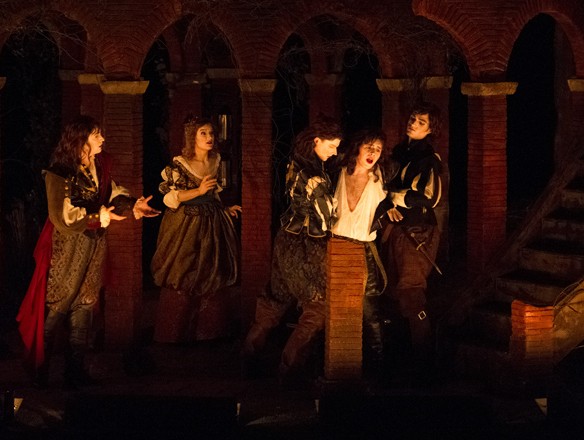
Anthony Tommasini and I review the same concert, four years and 2500 miles apart.
- Le Poem Harmonique at the Berkeley Festival, June, 2008
- Le Poem Harmonique at the Miller Theater, NYC, September, 2012
AND, Joshua Kosman saw this in 2008, Zerbinetta (Likely Impossibilities) saw it this year:
- Joshua Kosman in the Chron
- Zerbinetta was not happy at all with the presentation, for good reasons.
Wednesday, April 18, 2012
Compare & Contrast 21: FW-M Edition
Franz Welser-Möst brought the Cleveland Orchestra to San Francisco and points south, and there is some disagreement out there about the performances and the specific works!
- Joshua Kosman in the Chron thinks they're all over the place (Saariaho grey??)
- Richard Scheinen in the Mercury-News
- Janos Gereben in SFCV is in love
- Tim Mangan in the OC Register is positive
- SF Mike at Civic Center reminds of a few things about FW-M
- Opera Tattler covers program 1 and program 2 separately
- kalimac likes the playing and most of the music
- Mark Swed is happy with how they played and with FW-M; wish he'd written "Memento Mori" rather than "Momento Mori"
Friday, February 04, 2011
Compare and Contrast 20
Nixon in China finally reaches the Metropolitan Opera House. Anthony Tommasini and Martin Bernheimer report rather differently on the effects of amplifying the singers:
- Tommasini, in the NY Times: As with all his operas, Mr. Adams insisted that the singers wear body microphones. But even with amplification, the voices did not always emerge from the thick orchestration, with its synthesizer, two pianos, four saxophones and brasses aplenty.
- Bernheimer, in the Financial Times: And Adams' insistence on (over)amplifying the voices creates grotesque distortion.....[paragraphs later] The cast looked terrific, acted with ardour and, thanks to the microphones, sounded pretty awful.
Those comments are not necessarily mutually exclusive, and I'd suggest reading both reviews carefully. While Tommasini sounds like more of a fan of the opera than Bernheimer, read together the reviews aren't very far apart at all in assessing the particular weaknesses of the score. Their assessments of the singers are consistent. Tommasini is allowed a considerably larger word count than Bernheimer, who of necessity is terser and can't wax eloquent on what he does like. Importantly, he takes the space needed to note his own partial reassessment of Nixon.
I myself am curious about where each was sitting and what effect that might have had on the effects of the amplification. In the orchestra, of course, but where?
Readers of this blog know that I find it disappointing - okay, sometimes maddening - that Adams insists on the use of microphones. He has said himself that he doesn't care for typical operatic singing style, but he doesn't seem to get that amplifying the singers makes it worse for the audience and has a flattening and distancing effect on what the audience hears. I wish he would drop this and work differently with the singers.
I myself am curious about where each was sitting and what effect that might have had on the effects of the amplification. In the orchestra, of course, but where?
Readers of this blog know that I find it disappointing - okay, sometimes maddening - that Adams insists on the use of microphones. He has said himself that he doesn't care for typical operatic singing style, but he doesn't seem to get that amplifying the singers makes it worse for the audience and has a flattening and distancing effect on what the audience hears. I wish he would drop this and work differently with the singers.
Sunday, October 10, 2010
Compare and Contrast 19: Facebook as Valhalla
Alex Ross and Maureen Dowd: twins separated at birth? Probably not, but:
- On October 2, Alex discusses Social Network
- On October 10, Dowd gets the same idea
In between the Geek Feminist Network has a few things to say about the film.
Tuesday, June 30, 2009
Compare and Contrast 18, Italian Soprano Division
I forgot to mention in my comments on Tosca that while Adrianne Pieczonka has fine technique and a warm voice of ample size - certainly more than enough for the role - she doesn't sound at all Italian. Certainly this is partly owing to the fact that her Italian is on the loose side, lacking in bite - and so is her voice. It doesn't have the same kind of vibrancy or edge as an Italian spinto or dramatic soprano. I commented similarly on Heidi Melton and Stephanie Blythe in the Verdi Requiem. Excellent singers all, idiomatic in Italian, no.
Let's take a look at a few YouTube performances of the greatest of all Verdi arias, "Tu che le vanita," from Don Carlo, starting with Sena Jurinac. She sang many Italian roles in her long career, bringing to them deep understanding, a magnificent line, and pinpoint accuracy. But the weight of her voice isn't quite right, she doesn't have a strong chest voice, and the cool tone is more Strauss than Verdi. Still, it's an admirable performance, sorrowing and dignified.
Next, let's listen to a pair of legendary mid-century Italian sopranos, Renata Tebaldi and Anita Cerquetti. The cut of their voice couldn't be more Italian; both voices are big, rich, and vibrant, deep as a river.
Tebaldi is usually considered past her best by 1964, when this was recorded, but what I would give to hear the aria performed this way.
And here's the meteoric Cerquetti, in her very brief prime:
Missing from this collection, because she never recorded it: Rosa Ponselle, who sang Elisabetta in the 1920 Metropolitan Opera premiere. Now that must have been something, as young as she was. (And she was in good company, with Adamo Didur as Philip, Giovanni Martinelli as Don Carlo, Giuseppe de Luca as Rodrigo, and Margarete Matzenauer as Eboli.)
Subscribe to:
Posts (Atom)