Wednesday, December 13, 2017

San Francisco Tape Music Festival, 2018

How's this for a lineup? Press release:


Friday January 5, 2018 (9pm) 
Saturday January 6, 2018 (8pm) 
Saturday January 6, 2018 (11pm) 
Sunday January 7, 2018 (8pm) 


San Francisco

$20 general
$10 balcony/underemployed
$60 fest pass (general admission all 4 concerts)

or at the door (cash only) the day of show after 7pm


America's only festival devoted to the performance of audio works projected in three-dimensional space, The San Francisco Tape Music Festival features four distinct concerts of classic audio art and new fixed media compositions by 26 local and international composers. Hear members of the SF Tape Music Collective, along with guest composers, shape the sound live over a pristine surround system (24 high-end loudspeakers) with the audience seated in complete darkness. It's a unique opportunity to experience music forming - literally - around you. 

The 2018 Festival's first two concerts showcase the entire range of the “fixed media” artform; the Saturday late-night show presents longer, psychedelic, and ambient tape pieces; and the Sunday concert features an entire concert of “audio postcards” and “sound walk” compositions. Throughout the festival, composers from the empreintes DIGITALes label will be highlighted. 

Remembering the pioneering work of one of the fathers of musique concrète, Pierre Henry (1927-2017), the festival presents a performance of his seminal work, Variations For a Door And a Sigh (1963). Other tape music classics include Karlheinz Stockhausen's quadraphonic Gesang der Jünglinge (1956) and James Tenney's proto-plunderphonic composition, Collage No.1 (Blue Suede) (1961). 

Recent works by international artists Hildegard Westerkamp, Jonty Harrison, Francis Dhomont, Natasha Barrett, and others will be performed alongside bay area composers Thom Blum, Cliff Caruthers, Nathan Corder, Matt Ingalls, Fernando Lopez-Lezscano, Maggi Payne, Adam Sohn, Sophia Shen / Gabby Wen, Tim Walters, and Chamberlain Zhang. 


works by:

visit http://sfsound.org/tape for program order for each individual concert 


Tuesday, December 12, 2017

Blind Foolishness


What Bay Area performing arts organization does not have a place in its ticket purchase flow to make a donation?

I'm not necessarily going to tell you, but let me just say that this is one of the dumbest moves an organization can make. You have the attention of a subscriber or single-ticket buyer, a person who perhaps appreciates what you do, and you are not making it as easy as possible for that person to give you money. Moreover, it's the most wonderful time of the year, when people are figuring out their charitable deductions, and are most likely to give you a few bucks.

And yet, if you want to donate, you have to initiate a second process, and if you didn't save your payment info five minutes previously when you bought tickets, you have to enter it all again.

I suggested to this organization earlier this year that perhaps this was a mistake, but things are the same now. (I bought my tickets on the late side.) Le sigh. I donated; will others?

100% Cast Change Announcement

The fourth shoe drops and we now have 100% turnover since the Met season announcement in March:
Sir Bryn Terfel has had to withdraw from the Met’s new production of Puccini’s Tosca as he takes enforced rest due to vocal fatigue. Željko Lučić will sing the role of Scarpia on December 31, 2017, and January 3, 6, 9, 12, 15, 18, 23, and 27 (matinee), 2018.
“I am extremely disappointed to have to cancel these performances,” said Sir Bryn. “I was particularly happy to be returning to the Metropolitan Opera with this exciting new staging, and it is a terrible shame not to be a part of it.”
As a consequence of the change, Lučić, who was scheduled to sing the role of Alfio in Mascagni’s Cavalleria Rusticana, will be replaced by George Gagnidze for performances on January 8, 13 (matinee), 17, 20 (matinee), and 25, 2018. Lučić will still sing Alfio for the final two performances on January 29 and February 1, 2018.
Željko Lučić made his Met debut in 2006 as Barnaba in Ponchielli’s La Gioconda and has sung 12 roles with the company, including the title role in Nabucco, Amonasro in Aida, Count di Luna in Il Trovatore, and Iago in a new production of Otello which opened the 2015–16 season. His performances as Iago, the title role of Rigoletto, and the title role of Macbeth, opposite Anna Netrebko, have all been seen throughout the world as part of the Met’s Live in HD series. He previously sang the role of Scarpia at the Met in 2015.
Sir David McVicar’s new staging of Tosca, conducted by Emmanuel Villaume, opens on December 31, starring Sonya Yoncheva as Tosca and Vittorio Grigolo as Cavaradossi. The January 27 matinee will be transmitted live as part of the Met’s Live in HD series, which reaches more than 2,000 movie theaters in 73 countries around the world.
Later performances beginning April 21 will star Anna Netrebko in the title role opposite Marcelo Álvarez as Cavaradossi and Michael Volle and Lučić sharing the role of Scarpia. The April and May performances will be conducted by Bertrand de Billy.
To refresh your memory:

Kristine Opolais -> Sonya Yoncheva (June 16)
Jonas Kaufman -> Vittorio Grigolo (March 8)
Bryn Terfel -> Željko Lučić (December 12)
Andris Nelsons -> James Levine (July 10) -> Emmanuel Villaume/Bertrand de Billy (December 5)

Friday, December 08, 2017

More on James Levine

So the Met has canceled all of James Levine's performances this season, while it investigates; Ravinia has "cut ties" with him; the BSO has issued a statement about its due diligence before they hired him as music director (but now it turns out - surprise! - they'd heard the rumors but "saw no cause for concern"); Levine himself has issues a statement.

Let's take a look at some of this. Here's the BSO statement, which they put on Twitter (click to enlarge):


"We followed our standard procedures and decided to hire him. Nobody complained!" Well, sure. He wasn't going to approach adult women, girls, or adult men, and he wasn't going to assault minors at Symphony Hall. And apparently the vetting process, at least as described here, didn't include asking a few grad students or opera fans about Levine. We would have clued them in.

Seriously, it is not credible that the Met and BSO didn't know about the rumors. I heard them around 1980-82 when I was a musicology grad student at Stony Brook, from housemates who hung around Lincoln Center. Terry Teachout heard the rumors in the 1970s when he was living in Kansas City, a good 1200 miles from Lincoln Center, according to his WSJ article. And a fellow on Twitter mentions hearing the rumors in 1995, when he lived in Los Angeles and was 15 years old.

But wait - the BSO had heard the rumors! Not only that, but this extremely moving and intense piece by Ben Miller makes it perfectly clear that the rumors reached far enough that members of the BSO itself warned their children against being alone with Levine because they knew he was a pederast.

It's just amazing what institutions can manage to ignore or forget when an important person is involved.

As to Levine's statement, shudder. (Link is to Michael Cooper's NY Times article.) It is the very essence of a non-denial denial, the statement of a person who doesn't see how wrong his actions were. This is what Cooper's article quotes:
“As understandably troubling as the accusations noted in recent press accounts are, they are unfounded,” he said in a written statement. “As anyone who truly knows me will attest, I have not lived my life as an oppressor or an aggressor.”
“I have devoted my energies to the development, growth, and nurturing of music and musicians all over the world — particularly with the Metropolitan Opera where my work has been the lifeblood and passion of my artistic imagination,” he said in the statement. “My fervent hope is that in time people will come to understand the truth, and I will be able to continue my work with full concentration and inspiration.”
The second paragraph is mostly filler: I have lived a life of artistic good, including my work with musicians! I couldn't have done anything wrong! That stuff about his hope that "people will come to understand the truth" is nauseating and goes with "the [accusations] are unfounded" in the first paragraph. This all boils down to: "Sure, there was sex, but it wasn't the way my victims say! I didn't harass them and moreover the truth is that they were into it."

Well, no, they weren't. Read their accounts of how it felt to them at the time and what the long-term psychological effects of the abuse were.

Here's what you need to keep in mind: the four men's accounts are very similar. It's also apparent that there was some kind of cult around young James Levine; he had a coterie of followers. And the four men's accounts close resemble accounts by people who've been sexually victimized by authority figures such as priests and music teachers. (See reporting on the Royal Northern College of Music and Chetham's scandals, for example, and everything about sexual abuse by priests.)

I doubt that Levine will work again. The police report and publicity have made him completely radioactive. But, you know, this should have happened long ago. He has conducted plenty of performances with young choristers; he has taught here and there; he's had plenty of opportunities.

What I expect to happen: Peter Gelb will be fired for having sat on the Lake Forest police report for a year with no attempt at independent verification or investigation because "Jim denied it all." (OF COURSE HE DID. WHAT DID YOU EXPECT?) Perhaps the Met board will lose a few members. More recent police reports or victim accounts will surface. Maybe there were payoffs. Perhaps we'll find out whether Diva X really did get an opening night in exchange for getting him out of jail. And possibly one of the reports will be about actions that still fall under the statute of limitations, and there will be a trial.

Friday Photo: At the grave of Muzio Clementi


Westminster Abbey
May, 2014

Thursday, December 07, 2017

Girls of the Golden West, San Francisco Opera World Premiere


Davóne Tines (Ned Peters) and Julia Bullock (Dame Shirley)
Cory Weaver photo, courtesy of San Francisco Opera

AND it's December 12 and I've added John Rockwell.

It's December 9 and I've added John Masko and Patricia Wallinga to the list.

It's December 7 and I think I've got everything that will be published. If you spot someone else, let me know. Added today: Alex Ross, Hugh Canning, Batty Masetto, Michael Strickland.
I'm planning to read these soon and try to respond to a few comments in various reviews.

Further to Previous: Levine Replacements

The Met has announced who will conduct upcoming runs of Il Trovatore and Luisa Miller, replacing James Levine. Marco Armiliato gets Il Trovatore and Bertrand de Billy gets Luisa Miller.
Sir David McVicar’s production of Il Trovatore will feature Maria Agresta as Leonora, Yonghoon Lee as Manrico, and Anita Rachvelishvili as Azucena. Quinn Kelsey and Luca Salsi will share the role of Count di Luna, with Štefan Kocán and Kwangchul Youn both singing the role of Ferrando.
Performances of Il Trovatore are on January 22, 26, 30, Feb 3 (matinee), 6, 9, 12 and 15, 2018.
Elijah Moshinsky’s production of Luisa Miller features Sonya Yoncheva in the title role, with Plácido Domingo as her father. Piotr Beczała sings Rodolfo, with Olesya Petrova as Federica, Alexander Vinogradov as Count Walter, and Dmitry Belosselskiy as Wurm.
Performances of Luisa Miller are on March 29, Apr 2, 6, 9, 14 (matinee), 18 and 21 (matinee), 2018. The April 14 matinee will be transmitted live as part of the Met’s Live in HD series, which reaches more than 2,000 movie theaters in 73 countries around the world.

Tuesday, December 05, 2017

Claire Chase: Density 2036 at Cal Performances


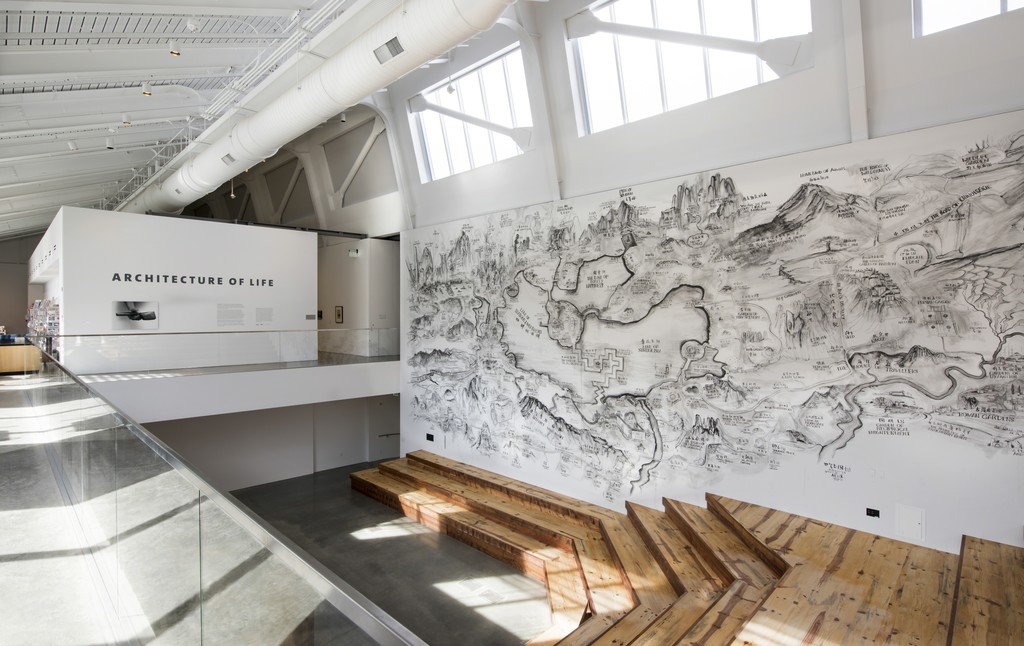
Space where the concert was held.


I was lucky enough to see the great flutist Claire Chase the other night at Cal Performances. The venue was the Berkeley Art Museum and Pacific Film Archive, and not in the theater where movies are shown. Instead, they used the stepped-down amphitheater right inside the building. Audience members with tickets could sit on the stairs; audience members without could stand and look down at the stage from the main-floor-level area.

It was one of those programs where, really, all you can do is gape, take notes, and come up with more and better superlatives, considering that Chase's performance was about as close to flawless as you can get. I mean, I didn't hear anything that sounded like an error or misstep, and she played for something like four and a half hours. It was an astonishing display of musicianship, technique, and sheer endurance.

I'd question just one decision she made about the program: her flutes were amplified for every piece she performed (21 in all), through a body mike. The venue was small and for most of the works, audibility would not have been a problem. Some of the pieces might well call for amplification, but I doubt that's the case for the pieces from before 2000 and certainly not for Varèse's Density 21.5. In some cases, the decision might have been made to make sure that the live flutes would be able to properly balance the recorded flutes and electronics. Fair enough, in those cases, but why for all of them?

As it happens, I've got a review of this concert in SFCV. I chatted with Louisa Spier from Cal Performances and heard that no SFCV reviewer was there, so partway through the marathon, I sent email reading "I'm at Claire Chase's program. Want a review? Signed, Former Flutist." They were happy to take one. Apparently the only other reviewer there was Joshua Kosman -- shocking, because, honestly, this was an extraordinary concert and I will fall over if it's not on both Joshua's and my best-of lists for 2017, or for the 2017-18 season.

Fortunately, since Chase is at the beginning of a 22-year-long commissioning program -- you read that right, twenty-two years -- you'll have a few more chances to hear her.

Nota bene: my word processor thinks both of these reviews are around 900 words.

Va, Tosca!

The Met announces most of the conductors who will take over the new Tosca from James Levine, who has been relieved of his duties following this weekend's news:
Emmanuel Villaume will conduct the Met’s new production of Puccini’s Tosca, on December 31, 2017, and January 3, 6, 9, 12, 23, and 27, 2018, replacing James Levine.
Maestro Villaume, who recently conducted Massenet’s Thaïs at the Met, is Music Director of the Dallas Opera and Music Director and Chief Conductor of the Prague Philharmonia. He made his Met debut in 2004 conducting Puccini’s Madama Butterfly, and his subsequent performances with the company have included Saint-Saëns’sSamson et Dalila, Bizet’s Carmen, Massenet’s Manon and Gounod’s  Roméo et Juliette.
Sir David McVicar’s new staging of Tosca opens on December 31, with Sonya Yoncheva as Tosca, Vittorio Grigolo as Cavaradossi, and Bryn Terfel as Scarpia. The January 27 matinee will be transmitted live as part of the Met’s Live in HD series, which reaches more than 2,000 movie theaters in 73 countries around the world.
Later performances on April 21, 26 and 30, and May 4, 8 and 12, 2018, will star Anna Netrebko in the title role opposite Marcelo Álvarez as Cavaradossi and Michael Volle and Željko Lučić sharing the role of Scarpia. The April and May performances will be conducted by Bertrand de Billy.
Gareth Morrell will conduct the performance on January 18, 2018. The conductor for the January 15 performance will be announced at a later date.

Sunday, December 03, 2017

The AFM Weighs In

The musicians' union, Local 802, AFM, has a statement:
December 3, 2017– The Associated Musicians of Greater New York, Local 802 AFM has released a statement on the allegations of sexual abuse on the part of Music Director Emeritus James Levine:
“We are horrified and sickened by the recently reported allegations of sexual abuse by Mr. Levine. The Metropolitan Opera has an obligation to all employees to provide a safe workplace free of sexual harassment and discrimination. Throughout history, artists have stood for our society’s values and priorities. As musicians of the MET Orchestra, Local 802 and members of labor unions, we have the power to bring about positive change. It is incumbent upon our community to decisively and immediately denounce actions of abuse, assault and sexual harassment.” — Tino Gagliardi, President, Associated Musicians of Greater New York, Local 802, AFM
I'm really pretty sure that there were members of the union who'd heard about this.

Statement from the Metropolitan Opera Regarding James Levine (and an Update)

Received about 20 minutes while I was putting up a pot roast to braise:
The Metropolitan Opera announced today that it is suspending its relationship with James Levine, pending an investigation, following multiple allegations of sexual misconduct committed by Mr. Levine that took place from the 60's to the 80's, including the earlier part of his conducting career at the Met. 
Mr. Levine will not be involved in any Met activities, including conducting scheduled
performances at the Met this season. The Met has appointed Robert J. Cleary, former United States attorney and currently head of the investigations practice at Proskauer Rose, to lead a full and complete investigation into the relevant facts. 
“Based on these new reports, the Met has made the decision to act now, while we await the results of the investigation,” said Peter Gelb, Met General Manager, whose actions are fully supported by the leadership of the Met Board and its Executive Committee. “This is a tragedy for anyone whose life has been affected.” 
There will be no further comments or statement regarding this issue from the Met at this time.
Multiple allegations from the 60s to the 80s? New reports? I must have missed something.

Here's the update, in a Times story from Michael Cooper:  three two more men, with their names in the paper, have gone to the Met to say "this happened." The third is the man who filed the police report.

Not the First Public Classical Music Abuse Story in the US

Updated & more strongly worded 12/3/2017

So no, this isn't the first, as I was saying yesterday. There's the Johannes Somary case, which came out a few years ago, after his death. There've been stories about other figures in classical music for decades, including at least one prominent composer, now deceased. And there were the Chetham's and RNMC scandals in Great Britain a few years back.

But the NY Post story on James Levine is likely a surprise to very few: there've been rumors about him at least since I first heard them as a grad student back in 1980-81. And it will be no surprise that neither the Met nor Peter Gelb has responded to the report's questions about the story. (Here is Michael Cooper's NY Times story, released a few hours after that of the Post. It includes a brief statement from the Met, which is opening an investigation.)

By the way, if you have a story about someone, and you are unable to discuss it publicly, the Times has a tip hotline. Read information on how it works here. It is almost always possible to make an anonymous tip or talk to a reporter on deep background.

New:

And now the Met and the BSO are telling us that they're shocked, shocked to hear about this. C'mon, people, this is total bullshit. If I heard about Levine in 1980-82, and a guy on Twitter heard it in Los Angeles in 1995 when he was 15 years old, there is no way that nobody on the Met Board of Directors or in management hadn't heard the stories. I mean, really: he wouldn't be abusing kids in the Met's orchestra pit, right?? Note the careful grooming of the man discussed in the Post story, whom Levine met for the first time when he was a boy of four (4) years.

The man at the center of the Post and Times reports isn't likely to be the only victim. And Levine isn't the only famous person you'll be hearing about in the next six months.

As I said to someone, or intended to say, a few weeks ago, if I were a journalist on this story, I'd be talking to the parents of Met Children's Chorus members right now. And I imagine there is enormous panic at Lincoln Center just now: how many donors, big or small, will keep giving to an institution that may have protected a child sex abuser for decades? If this is what happened, and if the company collapses, the Met will have sacrificed their entire staff for one person.

Friday, November 24, 2017

Ojai Festival News:

Artistic Director Thomas W. Morris will retire from the Ojai Festival after the 2019 festival, of which Barbara Hannigan will be the music director. He will have been Artistic Director for 16 years at that point. Press release after the cut.


Mariss Jansons' Foot Joins that of Andris Nelsons

In an interview in the Telegraph the other day, maestro Mariss Jansons put his foot in his mouth:
Hmm, well. Well I don’t want to give offense,” said Jansons, “and I am not against it, that would be very wrong. I understand the world has changed, and there is now no profession that can be confined to this or that gender. It’s a question of what one is used to. I grew up in a different world, and for me seeing a woman on the podium… well, let’s just say it’s not my cup of tea.
And now, in a statement released by the Bavarian Radio Symphony Orchestra, he's attempting to walk it back, not too successfully:
Our chief conductor Mariss Jansons has asked us to publish the following statement of his: 
“In a recent interview with the British newspaper ‘The Telegraph’,  a quote from me was published which has provoked considerable attention in the media. I would like to respond to this with the following statement:
I come from a generation in which the conducting profession was almost exclusively reserved to men. Even today, many more men than women pursue conducting professionally. But it was undiplomatic, unnecessary and counterproductive for me to point out that I’m not yet accustomed to seeing women on the conducting platform. Every one of my female colleagues and every young woman wishing to become a conductor can be assured of my support, for we all work in pursuit of a common goal: to excite people for the art form we love so dearly – music.”
In the United States, a gaffe is defined as "when a politician accidentally tells the truth." That first, unguarded remark very likely represents what is in Jansons' heart. I hope that he is taking the opportunity to go see MGT, Susana Mälkki, Marin Alsop, and their peers so that seeing women on the podium can become his cup of tea.

Dmitri Hvorostovsky

Dmitri Hvorostovsky
care of his personal web site


The great baritone Dmiti Hvorostovsky died on November 21 at 55. He had announced in 2015 that he was being treated for brain cancer. He was able to make some opera and recital appearances after that, but the tumor affected his balance and that made opera much more difficult for him.

He appeared at San Francisco Opera six times, and I saw all of them, from 1996's Barbiere (Figaro) to the most recent staging of Il Trovatore (di Luna). I'm sorry that the only Russian role I saw him in was in The Tsar's Bride. I'm sure he was a fabulous Prince Andrew in War and Peace and Onegin, in the eponymous opera.

He had a most beautiful voice, perhaps a bit on the light side for Verdi, but he made those roles work for him anyway. RIP, and condolences to his family and loved ones.

San Francisco Opera 2018 Adler Fellows

SFO sent a press release announcing the 2018 Adler Fellows the other day. The opening of Girls of the Golden West naturally got a lot of attention, and now it's time to shine a light on these talented youngsters. From the press release:
The eight singers selected as 2018 Adler Fellows are sopranos Sarah Cambidge (Vancouver, B.C., Canada) and Natalie Image (Tsawwassen, B.C., Canada); mezzo-soprano Ashley Dixon (Peachtree City, Georgia); Aryeh Nussbaum Cohen (Brooklyn, New York), who becomes the fourth countertenor to join the program after Brian Asawa, Gerald Thompson and Ryan Belongie; tenors Amitai Pati (Auckland, New Zealand) and Kyle van Schoonhoven (Lockport, New York); baritone Andrew G. Manea (Troy, Michigan); and bass-baritone Christian Pursell (Santa Cruz, California). Natalie Image, Ashley Dixon, Aryeh Nussbaum Cohen and Christian Pursell are incoming first-year Adler Fellows. Sarah Cambidge, Amitai Pati, Kyle van Schoonhoven and Andrew G. Manea return as second-year fellows. All artists begin their fellowships in January 2018, except for Aryeh Nussbaum Cohen who begins in July 2018.
Director Aria Umezawa (Toronto, Canada) continues her fellowship for a second year. Umezawa will participate in all aspects of fellowship training, including dance classes, language classes and score studies. She will also work with the Adler Fellows on their audition repertory and participate in other San Francisco Opera Center activities. This December, she stages the Opera Center’s The Future Is Now concert showcasing the 2017 Adler Fellows performing with the San Francisco Opera Orchestra at the War Memorial Opera House.
The pianists selected for Apprentice Coach Fellowships are first-year fellow César Cañón (Bogotá, Colombia) and returning second-year fellow John Elam (Cleburne, Texas). The Adler Fellow apprentice coaches work closely with Mark Morash, Director of Musical Studies of the Opera Center, and John Churchwell, Head of Music Staff at San Francisco Opera. The coaches participate in the musical activities of both San Francisco Opera and the Opera Center, and they are involved in all aspects of the Adler Fellows’ training by acting as pianists for master classes, working with master coaches and preparing the Adler Fellows for concerts and mainstage roles.

Friday Photo


Parish Church and Graveyard, Battle (St. Mary the Virgin)
May, 2014

Tuesday, November 21, 2017

Andris Nelsons, Further to Previous

The BSO released an update from Andris Nelsons on the matter of sexual harassment in the classical music world.  It's unfortunately a jpg or something; I can't find the text on the BSO web site's press section, but I will transcribe it below.

You can pretty much tell which sentence come directly from Legal and/or Public Relations:
During a recent interview with Jim Braude and Margery Eagan on WGH's Boston Public Radio I did not express myself as clearly as I would have liked when asked about the issue of sexual harassment in the classical music world. In my own experience working in the classical music industry for many years, I myself have not seen overt examples of sexual misconduct in my day-to-day work life. That being said, this kind of offensive behavior, unfortunately, takes places in all fields, including, of course, the classical music industry. All of us in the field must remain constantly vigilant and fight against all types of inappropriate and hurtful behavior, and continue the essential work of creating a fair and safe work environment for all classical musicians. Though involvement in music and the arts can't cure all the ills of society, I do believe that the inspiration they provide has the potential to help us reflect at times on the better angels of our natures. Or more simply put by Beethoven -- the genius composer of the Ode to Joy symphony, considered the universal anthem of brotherly/sisterly love -- "Music can change the world."


I have to say, this is pretty awful. Fake Beethoven quote; "I've never seen it myself", which is so often a way to cast doubt on those who have, and which is most easily said by powerful men whom nobody IS going to harass, and nobody will harass another in front of; unwarranted belief in the inherent goodness of a musical style; citation of a work that has a wide variety of associations; "I didn't express myself as clearly as I would have liked." No, you didn't; it's pretty clear that you believed what you originally said and had to be talked down.

Monday, November 20, 2017

Andris Nelsons Puts His Foot in His Mouth, Bigtime

Headline in the Boston Globe:


Nelsons made this ridiculous claim last week, on Boston's public radio station. He missed the stories about Dale Clevenger, former principal horn of the CSO; he must have missed the much more recent stories about harassment at Berklee College of Music in Boston (not primarily a classical music school, but still). And apparently he wasn't paying attention during the part of the his training as a new manager at the BSO that covered sexual harassment law. (If that wasn't covered, it should have been.)

By now, the BSO legal department has probably got him in their office explaining that just by making that statement, he created an environment in the orchestra where anyone being sexually harassed might be afraid to come forward, since their music director has said that it's just not a problem in classical music. And perhaps Kristine Opalais has had a word or two with him as well.

Friday, November 17, 2017

Girls of the Golden West: Go See It!

If you read this blog, you know that next week San Francisco Opera will present the premiere run of performances of Girls of the Golden West, by John Adams, libretto by Peter Sellars, directed by Peter Sellars.

I have not seen it, I have heard only the short orchestra bit "Lola Montez Does the Spider Dance," I have seen the same public photos everyone else has, but I'm telling you, get a ticket and see this. It's not often that a great composer like Adams writes an opera, and lots of composers - I'm looking at you, Ludwig van - don't have the theatrical flair you need to write successful operas. So Adams is sitting in a particular sweet spot in musical history, along with, say, Mozart, Berg, Britten, Shostakovich, and a few others I could name who excelled in orchestra music, chamber music, and operas.

So get a ticket. I haven't read the libretto yet, haven't seen the staging, haven't heard a note of the music. There's likely to be some terrific music, even if, at the end of the night, you are scratching your head about one or another aspect of the opera.

Here are a couple of previews, by Georgia Rowe and Michael Cooper:


Friday Photo


Sunny assists me in studying for the world premiere of Girls of the Golden West
October, 2017

Tuesday, November 14, 2017

Anxiety Dreams

Historically, I don't have a lot of nightmares or anxiety dreams, and the ones I have tend to be of the crumbling-teeth variety. The other day, though....

I woke up from a dream in which I had somehow been appointed to conduct the world premiere of Girls of the Golden West. And it was two weeks until the date, and nobody had provided me with the score.

I have basic conducting skills, it's true, but they are very basic and  they have deteriorated since grad school, when I was an assistant conductor of one of the choruses at Stony Brook and led sectional rehearsals of the Missa Solemnis. I led a rehearsal of a very tiny chorus doing comparatively uncomplicated music earlier this year, with no personal rehearsal of the pieces we worked on, and I could wing it fairly well. But there is no way I could conduct a John Adams opera without lengthy study. NO WAY, you hear me?

Realistically speaking, if Grant Gershon is not, for some reason, able to conduct, the most likely substitute is JCA himself. There can't be many people who know the score well enough to step in and conduct GGW.

Sunday, November 12, 2017

Reading Russell Platt? If Not, You Should Be.

The New Yorker is lucky enough t have two first-class classical music writers on board. I'm sure you know Alex Ross's work, and his books, and I hope you're also reading writer, editor, and composer Russell Platt, whose short articles appear on line, but not in the printed New Yorker. If not, you can start here, and I'm sure you will like what you read.

Saturday, November 11, 2017

Compare & Contrast 33: Gardiner in NY

John Eliot Gardiner and the Monteverdi Choir spent six months touring with the three surviving Monteverdi operas. They hit New York the other day; Justin Davidson and Anthony Tommasini were there, and wrote the following sharply different reviews; Alex Ross is less enthused than Tommasini, but still very complimentary to the performers, with none of Justin's snark and a lot of penetrating commentary about Monteverdi's greatness:
Long ago, A.C. Douglas was incredulous that I'd rank L'incoronazione di Poppea with Le Nozze di Figaro, but after seeing four productions, I'll stick with that assessment. It is among the very greatest of operas.

Updated on Saturday, Nov. 11, to add Alex Ross's review and my closing comment, then bumped to the top of the blog again.