Thursday, June 16, 2016

For Fans of the Gigantic


By Kathinka Pasveer - Kathinka Pasveer, CC BY-SA 3.0 
https://commons.wikimedia.org/w/index.php?curid=8385702

The 2019 Holland Festival is, somewhat unbelievably, going to stage Stockhausen's Licht cycle of seven (7) operas, one for each day of the week. From a (government?) document covering several years of upcoming artistic activities in the Netherlands:

In 2019 brengt het festival een integrale uitvoering van Licht van Karlheinz Stockhausen in wereldpremière.

At 29 hours of music, it's a lot longer than Der Ring des Nibelungen.

Yes, I'm planning to go.

H/T Alex Ross, who tweeted the link earlier today.

Wednesday, June 15, 2016

Gockley Gala: Sasha Cooke Replaces Susan Graham


Susan Graham is ill, and Sasha Cook is stepping in to sing a couple of numbers. Here's the press release from San Francisco Opera, including Graham's heartfelt tribute to David Gockley. (I won't be at the gala, unfortunately. Duty calls.)

SAN FRANCISCO (June 15, 2016) – San Francisco Opera today announced that it has amended the list of international singers performing at the David Gockley Gala Concert on Thursday, June 16 to now include Sasha Cooke in lieu of Susan Graham, who has withdrawn due to illness. Cooke will sing in the Act III trio “Hab’ mir’s gelobt” from Der Rosenkavalier and Didon’s aria “Ah! Je vais mourir…adieu, fière cité” from Les Troyens.

American mezzo-soprano Sasha Cooke made her San Francisco Opera debut in the title role of Mark Adamo’s world premiere opera The Gospel of Mary Magdalene in 2013. She subsequently returned to the War Memorial Opera House in 2015 as Anna in Les Troyens and later as Magdalene in Die Meistersinger von Nürnberg. Cooke is a frequent collaborator with Michael Tilson Thomas and the San Francisco Symphony appearing in concerts both locally and on tour.

Susan Graham has sent the following message to David Gockley and the Company:

“To say that David Gockley has greatly contributed to the course and arc of opera in America, would be an understatement. We are all aware of his championing of new works, and supporting American composers in Houston and in San Francisco. With one of the earliest young artist programs in America, created at the Houston Grand Opera under his long tenure there, it’s obvious his care and nurturing of young singers was a priority from the beginning.

“Growing up in Texas, I was always aware of the impact David was making with HGO, and when I was finally hired there, I got to witness his love for singers and singing firsthand, which continued to flourish in San Francisco, forging and unifying this company in the last 10 years. He believed in me, challenged me, supported me, and in last summer’s Les Troyens here at SFO, he gave me the greatest operatic experience of my entire career.

“He is unique in his field, with his experience as a singer, his vast knowledge of the profession, and his passionate devotion to the highest quality. I love this guy, and I wish him and Linda Kemper a beautiful, RELAXING, well-deserved life in retirement, confident that the Gockley Impact will be felt for generations.”

Lyric Opera, You Tease!


Click Buy Tickets and you see this:


Click one of those date links, scroll down, and....


For anyone needing a refresher, here are my personal reasons for going: Christine Goerke, Cassandre; Brandon Jovanovich, Énée; Sophie Koch, Didon; Lucas Meachem, Chorèbe; Christian Van Horn, Narbal; Okka von der Damerau, Anna.

And the star of the show, Hector Berlioz.


Tuesday, June 14, 2016

San Francisco Opera Admits It: "We're trying to sow confusion."

     
John Adams and Peter Sellars ©Terrence McCarthy/San Francisco Opera

Okay, that's a lie. What's really going on is that somebody gave John Adams and Peter Sellars very bad advice about the name of their new opera, which will be about California during the Gold Rush era. Here's the opening of the press release, which confused me rather badly:


SAN FRANCISCO OPERA TO PRESENT WORLD PREMIERE OF
GIRLS OF THE GOLDEN WEST
A NEW OPERA BY JOHN ADAMS WITH A LIBRETTO BY PETER SELLARS
WAR MEMORIAL OPERA HOUSE, FALL 2017

The new work, set during the 1850s California Gold Rush, is a
San Francisco Opera Co-Commission with
The Dallas Opera, Dutch National Opera and Teatro La Fenice

Cutesy is just not going to work in this case, although if they don't change the opera's name, opera houses in Anglophone countries will have to use La Fanciulla del West for Puccini's masterpiece.

The press release has nothing about casting, stage design, lighting, or costumes, but it refers to Sellars as "director/librettist," so I believe we can safely assume who will direct.

Given the many, many problems with the Doctor Atomic libretto, I wish that a librettist had been hired to write this libretto, but maybe Gene Scheer and J. D. McClatchy didn't have room on their calendars.

SFO Don Carlo: Media Roundup and Further Commentary

Michael Fabiano (Don Carlo) and Mariusz Kwiecien (Rodrigo)
San Francisco Opera, Don Carlo
©Cory Weaver/San Francisco Opera


My Don Carlo review, filed late yesterday, won't be up until this evening or tomorrow, owing to technical issues at SFCV. is now posted. Briefly, it's a great musical achievement, not so much on the theatrical side.

Here are links to those reviews that I know about; in the absence of mine, just read Joshua Kosman's. He's more concise and a lot snappier than I am, but we are in accord, all the way to telling the company to dump the Sagi production, already.

Or, in my opinion, get a better director; I dislike the sets but they can be made to work. I spell out more of the foolishness of the production and direction than Joshua; that all the characters do is stalk around the stage before they stand and sing is the least of the problems.

The SFO press photos even capture a scene that shouldn't have happened, another laugh-inducer during a deadly serious scene. This is the garden scene, where the only blade that should be drawn is Rodrigo's dagger, but this production somehow has Eboli drawing Carlo's sword and threatening him with it.

Michael Fabiano (Don Carlo) and Nadia Krasteva (Eboli)
San Francisco Opera, Don Carlo
©Cory Weaver/San Francisco Opera

I noted in my review that Fabiano and Martinez both needed more help than they got from Sagi, to which I must add: boy howdy. Fabiano spends an awful lot of time with his chin in the air singing to the chandelier instead of to her. Their facial expressions hardly changed in Act I; there's a bit in there where he chases her around the table trying to kiss her, which, honestly, I just don't think is happening in the 16th c. between a Spanish prince and a French princess. Not to mention: why is there a table in the middle of a forest? For a picnic, maybe? And why are they wandering around in the middle of winter without cloaks?

I'd also like to know whether there's historical precedent for the Inquisition hanging puppets as part of an auto-da-fe. I mean, maybe there's a reason for having a few heretics and a couple of puppets marching to the scaffold.

And I gotta say, I fell over at Joshua Kosman's observation that the auto-da-fe looks more like a farmer's market.

You get it: there's a lot in the direction that doesn't make any sense at all. There's no attention to detail, and that's why there's so much unmotivated wandering around on stage. This works for Pape in the King's Act IV scene; it's late, he's restless and unhappy and haunted. For everyone else, not really.

Sunday, June 12, 2016

A Graphic Guide to Don Carlo

You think Simon Boccanegra is tough to understand, try Don Carlo. Simon's problems sort themselves out as soon as you figure out who the Guelphs and Ghibbelines are, and that that Amelia is Maria and that Andrea Grimaldi is Jacopo Fiesco.

Okay, maybe that's not so easy. But Don Carlo has what can only be called rather tangled relationships among its principal characters. Here's a handy guide to at least some of what's going on. There's some ambiguity in the relationship between Rodrigo and the King, and Eboli and Elisabetta's relationship, initially warm, undergoes, ahem, a radical shift after Eboli's double, or maybe I mean triple, betrayal of the Queen. I will happily accept clarifying suggests about this graphic; just add them to the comments.


I would definitely suggest a close reading of the libretto. I happen to have the tri-lingual ENO libretto, which appears to contain every word everyone ever wrote to be sung in this opera. I alternated between reading the late Andrew Porter's singing translation and the original French.


Saturday, June 11, 2016

Opera Quarterly: Free to a Good (Bay Area) Home


I've got about 25 issues of Opera Quarterly that I would like to give away. I bought them in the 90s via eBay. They are from the 1980s. Some are damaged.

If you're in the Bay Area and you would like these, they're yours. You will have to come get them, although you can negotiate with me if you live between San Leandro and El Cerrito. Let me know in comments or by email if you'd like these. Otherwise, they get recycled in a week or two.

I will throw in a few issues of Lapham's Quarterly for good measure. These are from 2011-12 and have never been read; I somehow got a free one-year subscription through my job. I threw them collective against the wall when one issue, about The Future, had articles by at most eight or ten women among 90 contributors. That certainly tells you something about their view of the world.

Friday, June 10, 2016

Addendum to Germany Friday Photo


In truth, the brunch buffet at the Arvena Kongress was awesome, with infinite quantities of eggs, non-scary meats of all kinds, superb bacon, cereals, juices, killer muesli, tea, coffee, dairy, etc., etc.

Oh, and some unusual salads. Herring and beets? Works for me, but not everybody.

Germany Friday Photo


Terrifying German lunch meat
Arvena Kongress Hotel, Bayreuth
August, 2015


Thursday, June 02, 2016

Ryan Folds

Not that I ever thought Paul Ryan had the slightest bit of credibility - read Paul Krugman on the "magic asterisks" in Ryan's phony budget proposals - but his endorsement of Donald Trump would have destroyed any credibility he might have had.

Here's what he wrote:
“Through these conversations, I feel confident he would help us turn the ideas in this agenda into laws to help improve people’s lives,” Mr. Ryan wrote. “That’s why I’ll be voting for him this fall.”
Translation: A known con man is the best candidate to help the Republican Party's continuing efforts to con the American people.

Dissecting the Press Coverage


The NY Times demonstrated the power of the embargoed press release by having three articles about the changing of the guard at the Met posted about 30 seconds after the official press release was mailed out. In honor of that, here's some random commentary on the Met, YNS, and how the press, okay, the Times, is talking about it all.

First off, no one is the slightest bit surprised, perhaps owing to the fact that rumors had circulated for years that YNS was the Met's, or Peter Gelb's, first choice to succeed James Levine. The speed with which the announcement was made following Levine's decision to step down means that the negotiations had very likely been going on for some time.

I personally see it as a big problem that it will be four years before YNS goes from Music Director Designate to Music Director, but Peter Gelb tries to put a nice spin on it:
Long waits are not unusual in the classical music world, where major organizations and top talents typically plan their schedules four or five years in advance. Peter Gelb, the Met’s general manager, said that he felt fortunate that Mr. Nézet-Séguin would be available by 2020. “It required some juggling for him to be able to come as early as then,” he said in an interview.
Riiiiiight. I mean, this is true, and yet it's unfortunate in the context of what the Met needs. Anthony Tommasini spells this out in detail in his analysis of the appointment. (Tommasini unfortunately continues to hallucinate fantasize about Esa-Pekka Salonen coming on board as an interim MD, a position he would share with Bernard Haitink, who is 87. Stop, already, and daydream about something realistic, like Salonen conducting regularly at the Met. Or the Met commissioning an opera from Salonen. But right you are, Tony,  about that Luisi appointment.)

There's been concern in the press / blogosphere / Twittersphere over how forward-looking YNS might be as MD of the Met. In the same article I've quoted above, there's this:
Mr. Nézet-Séguin said that he considered the Met “the standard-bearer of our art form in the world,” and that he looked forward to conducting a variety of works there, including forgotten masterpieces that he would like to revive and new works, including world premieres.
Some cautious optimism about future repertory is thus justified, though we won't know for a while what he has in mind. (At this early stage, he might not either, but let me say SCHREKER and also Symanowski's great opera King Roger, which seems to be coming into its own at long last. I will nominate Nelsons, Jurowski, or Salonen as potential conductors of all of these, although ahem King Roger might particularly appeal to YNS himself.) In any event, it would be hard to be less behind new operas than the reluctant Levine.

Color me puzzled by Tommasini's claim about Levine "making the operas of Debussy, Berg and Stravinsky central to the Met's repertory." Pelleas was performed 62 times before 1972 and has been performed about 55 more times since then. There've been 44 performances of Lulu and 69 of Wozzeck, of which 18 were before Levine. The Rake's Progress has gotten a big 26 performances, with 31 of Le Rossignol and 23 of Oedipus Rex. C'mon, it's purely blowing smoke to claim that those three composers are in any way "central."


Headlines We Didn't Use

Met Appoints First Openly Gay Music Director

YNS: Making Opera Gay Again

Press Release Confirms James Conlon's Availability for San Francisco Opera Job

Met Confirms That The Rumors Were Right

The Seemingly-Inevitable Comes to Pass


Here's the press release from the Metropolitan Opera confirming what has been the rumor for the last....year? two? about their next Music Director: it will, indeed, be Yannick Nézet-Séguin.

I have not heard him conduct live or on record or on a Met broadcast, so I have no personal opinions about his conducting. I do, however, have an opinion about these points from the Met press release:
In the Met’s 2017-18 season, Nézet-Séguin will assume the interim title of Music Director Designate. He will become Music Director in the 2020-21 season, the first season in which he is available to take over the full responsibilities of the position. However, he will immediately become involved in the company’s artistic planning, which happens many years in advance.
[several paragraphs later]
Since 2012, Nézet-Séguin has been Music Director of the Philadelphia Orchestra, which announced today that he has extended his contract with them through 2025-26. (A separate press release on that announcement is available.) Given the close proximity of New York and Philadelphia, Nézet-Séguin will be able to easily commute between his two posts, and the Met and the Philadelphia Orchestra will also be exploring the possibilities for artistic collaboration between the two institutions.
He is also the Music Director of Montreal’s Orchestre Métropolitain and of the Rotterdam Philharmonic, a position he will resign at the conclusion of the 2017-18 season.
So...it will be four years before YNS can take up his full responsibilities; he will remain MD of the Philadelphia Orchestra (an important job at an important orchestra that, like the Met, has some big problems), and he will retain his longterm job at the Orchestre Métropolitain. 

This worked out so well when James Levine was at the Met and the Boston Symphony. Yes, YNS is 30 years younger and a lot healthier than Levine. Still. How many of these jobs can a music director do, and do well? Why don't organizations realize that there's enough conducting talent in the world to limit the talented to one job each?


Wednesday, June 01, 2016

xkcd Map Age Guide

Okay, stop whatever you are doing - reading this blog, obviosly - and go read xkcd's Map Age Guide. Every last bubble, please.

Surveys

Arts organizations send me online surveys about one thing or another at least once a month; sometimes I get one a week. This week, I got two in one day. 

One was the Metropolitan Opera, asking me about Met Opera on Demand. The other was from San Francisco Symphony, trying to find out what I think of their advertising.

These surveys very often fail to ask the questions I'd like to answer, so a suggestion for every last arts organization that conducts surveys: provide a free form text box with the question "Is there anything else you'd like us to know?" or something to that effect. You will get interesting answers.

For myself, I don't care about most of what's on these surveys. I go to concerts and opera performances to hear music, and what I care about most is repertory that I've never heard. I do not care what SFS ads look like and they have no effect on whether I buy tickets. I care about what's being performed and who is performing it. I told the Met that what I wanted from Met Opera on Demand was the same thing I wanted from the Met: haul yourselves out of the 19th c. and perform more music, a lot more, written after Turandot. In fact, consider annual commissions and shifting the repertory radically toward operas written after 1926. (Yes, Turandot is approaching its 100th birthday.)

Sunday, May 29, 2016

Carmen Media Roundup, San Francisco Opera, June 2016

©Cory Weaver/San Francisco Opera

I just sent off my review to Classical Voice North America; no idea when it will be posted, but here's the really short version: shockingly conventional and dull, singers without much drama on opening night. Why tell everybody for a year about how provocative Calixto Bieito is, then deliver this??

Here's what everybody else thinks:
(About the photo: if you're wondering what a giant bull is doing behind the smuggler's lair, I wondered too.)

Friday, May 27, 2016

Levine, Met Orchestra, Goerke, Vinke

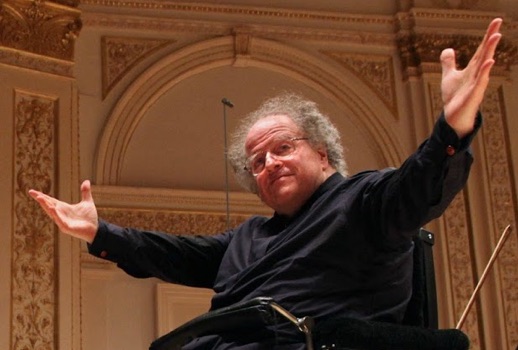
James Levine at Carnegie Hall
Photo via Parterre Box

Reviews are starting to arrive for last night's Met Orchestra program at Carnegie Hall - perhaps the last to be conducted by James Levine, a sad milestone.
I expect a few others to weigh in.

Germany Friday Photo


Streetcorner, Bayreuth
August, 2015

Friday, May 20, 2016

Wednesday, May 18, 2016

Luisotti to Leave San Francisco

Nicola Luisotti
copyright Terrence McCarthy/San Francisco Opera
used courtesy of San Francisco Opera


Well, well: here´s a surprise in my mailbox: Music Director Nicola Luisotti will leave San Francisco Opera in two years, at the end of the 2017-18 season. When David Gockley´s retirement was announced, the press conference also announced a two-year extension of Luisotti´s contract, presumably to provide continuity for the incoming General Director, now known to be Matthew Shilvock.

So, one of his first big jobs will be to find a new Music Director for the company.  As Joshua Kosman´s Chron article says, Luisotti was appointed in part to strengthen the company´s commitment to Italian opera. The end result of this is next season, with seven Italian operas out of nine productions. I´d say it´s time to strengthen the company in other areas.  I have not been impressed by Luisotti´s ventures into Mozart, Wagner, or R. Strauss.

I also note, with interest, that as of now Luisotti has no other full-time appointment. I suggest thinking about the possible implications of this. And there´s this in the press release:
I want the Company’s General Director Designate Matthew Shilvock to be able to move freely into the future with his ideas, his artistic interests and to take San Francisco Opera into a new direction.
Best of all, I can now tout my favorite candidate for the Met job for this one: James Conlon, a terrific conductor with broad interests and great skill across an extremely wide repertory.

Saturday, May 14, 2016

Don't Forget: The Amazons are Coming!

That's the Ars Minerva production of Le Amazzoni nella Isole Fortunate (The Amazons in the Fortunate Islands) is on May 21 and 22, at the Marines Memorial Theater in San Francisco. Be there or be square!

Friday, May 13, 2016

San Francisco Opera Cast Change: Carmen

Maxim Aksenov has withdrawn from the upcoming San Francisco Opera production of Carmen "for personal reasons." Brian Jagde replaces him in four performances, Adam Diegel in one. This means Jagde is singing Don José in 10 of the 11 performances. This is director Calixto Bieito's US opera debut; the production is being staged in SF by Joan Anton Rechi.

Note that there's a free simulcast to the ball park on July 2.

Additional Thoughts on the Met, James Levine, and YN-S

Last month, when James Levine's retirement was finally announced by the Met, Anthony Tommasini and Alex Ross had a mind-meld on one matter.

Alex Ross in The New Yorker:
The chief failing of the Levine era at the Met was the company’s sparse, spotty record with contemporary opera. Not until 1991 did Levine get around to presenting a world première, in the form of John Corigliano’s “The Ghosts of Versailles.” That piece has found a footing in the American repertory, but its successors at the Met—Philip Glass’s “The Voyage,” John Harbison’s “The Great Gatsby,” Tobias Picker’s “An American Tragedy,” and Tan Dun’s “The First Emperor”—are a rather miscellaneous group. Levine’s apparent lack of enthusiasm for such major opera composers as John Adams, Thomas Adès, and Kaija Saariaho seemed to delay their progress toward the Met. Latter-day masterpieces like Bernd Alois Zimmermann’s “Die Soldaten,” Ligeti’s “Le Grand Macabre,” and Messiaen’s “Saint François d’Assise” have gone unheard there.
Anthony Tommasini in the Times:
Still, over the years Mr. Levine conceded that he had not done enough to make the Met a vibrant space for new opera. He described the company as a big, hard-to-push institution, which in many ways it is. Yet in 2013, I was dismayed to hear him address this topic on “Charlie Rose.” Some people, Mr. Levine said, have argued that the Met should present a new opera every year. To that he answered, “I wish I really thought there was a new opera good enough for the Met every year.”
That last remark...it is very sad that what comes to mind as a response is "Jimmy, you needed to get out more." There is no paucity of new operas good enough for the Met. The Met should have been commissioning the great composers of our day and building a repertory of great works.

This brings us to Zachary Woolfe's article in the Times about his interview with Yannick Nézhet-Séguin, music director of the Philadelphia Orchestra and widely rumored to be the prime candidate to succeed Levine. First, there's the dismaying line about Philly being among the most conservative American orchestras: one longs for the days of Leopold Stokowski and his unending thirst for the new. Just look up the number of important early 20th c. works that got their first US performances under him.

Then there's this:
When I asked him, though, which underappreciated composers, works or corners of the repertory he might seek to champion — the Nézet-Séguin equivalents of Mr. Levine’s advocacy for Berg, marginalized Mozart or “Moses und Aron” — he seemed slightly at a loss.
“It’s still a bit at the beginning,” he said of his career. “I’m still at the stage when I enjoy so much broadening my repertory and the orchestra’s. If someone was someday to say, ‘Yannick has helped bring back this composer,’ I’m not sure who it would be.”
I love their operas, but it's sad that Woolfe has to reach for Berg, Mozart, and Schoenberg to find Levine's advocacy for the new and unusual, considering how long Berg and Schoenberg have been gone.

And unfortunately, if it is to be YN-S at the Met, don't expect heaps of commissions or the sudden prominence of, say, Schreker. For that, the Met ought to hire my favorite candidate, James Conlon.

Germany Friday Photo


Floor tiling outside Tannhauser Apotheke
Bayreuth, August, 2015