Showing posts with label Runnicles. Show all posts

Monday, December 22, 2025

The Best of 2025


Kang Wang as the title character
The Monkey King
San Francisco Opera
Photo: Cory Weaver, courtesy of SFO
 

SFCV published the writers' collective opinions of the best performances of the year. The Bay Area list is here. My five choices were these:

  • Esa-Pekka Salonen's Mahler 2
  • Poiesis Quartet at Noe Music
  • The Monkey King at San Francisco Opera
  • Pivot Festival, Carla Kiehlstedt's 26 Little Deaths
  • Tartuffe, Pocket Opera
It was a tough call. Here's the rest of my long list:

  • La bohème at SFO; a seriously great run, beautifully directed, with two terrific casts.
  • MTT 80, a deeply touching celebration of the man.
  • Parsifal at SFO
  • Rigoletto at SFO
  • Bluebeard's Castle at Opera San José
  • Turn of the Screw at SFCM, better staged and conducted than what I saw at Santa Fe over the summer.
  • John Adams third piano concerto, After the Fall, at SFS. I couldn't include the concert on my short list because the second half was (&)%$)_@_ Carmina Burana.
  • Dalia Stasevska at SFS, in the Thorvaldsdottir cello concerto and RWV's Fantasia on a Theme of Thomas Tallis.
  • Cabrillo Festival, Becoming
  • Hello, Star at OP. Just a perfect 45 minutes of opera begging for a larger orchestra. A wonderful libretto, beautiful music, great direction on a tiny stage.
  • Donald Runnicles and Irene Roberts at SFS
As you can see, I named four of the last six operas at SFO as among the best things I saw; Dead Man Walking was also superb. SFO had a stupendous year and in fact has been on a roll since the centennial season. Hats off to Matthew Shilvock and his team for this long string of artistic successes, which has also included a fair number of sellouts.

As for the flip side, I am going to pass on flagging concerts I found disappointing or wrong-headed. There's not much doubt that the worst event of the year was Esa-Pekka Salonen's departure from San Francisco Symphony after just five years as music director. He reinvigorated the orchestra's programming, led many great concerts, hired many terrific musicians, and thanks to the short-sightedness of the board and management, which couldn't figure out how to fund his ambitions for the future, he is gone.

Saturday, September 27, 2025

Runnicles at San Francisco Symphony


Donald Runnicles
Courtesy of his website

Well, I was extremely happy with this week's SFS program, which featured Donald Runnicles conducting Berg's Seven Early Songs and Mahler's First Symphony. For the Berg, he had mezzo-soprano Irene Roberts as soloist, and...her performance was a revelation.

Roberts has sung at SF Opera five times since 2013, in these roles:
  • Giulietta, Tales of Hoffman
  • Carmen, Carmen
  • Bao Chai, Dream of the Red Chamber
  • Dorabella, Così fan tutte
  • Offred, The Handmaid's Tale
Seeing her in these roles would not have prepared you for the vocal splendor she brought to the Berg, which was gorgeously, immaculately sung. Over in Europe, where she was a member of the ensemble at Deutsche Oper Berlin, she's been singing roles like the above, but also the great Wagner mezzo and Zwischenfach roles. I can imagine that they are magnificent, and I can only hope that she'll be in future Wagner productions at SFO, in roles that would be ideal for her.

As it happens, Deutsche Opera Berlin is where Runnicles headed after SFO, a position he'll be leaving at the end of the 2025-26 season. He is also the chief conductor designate of the Dresden Philharmonic this season, a position he will hold for some time to come. I was wowed by his Mahler, and I've been a fan of his for years, so I consider the people of Dresden to be lucky indeed.

[Update, 9/30: I have now had three people whom I'd consider to be very knowledgeable ask me why Runnicles isn't the music director of S.F. Symphony, and another speculating that maybe he could be principal guest conductor. Well, see the above; he seems to be very happy working in Germany, and also, he doesn't really have an ongoing relationship with the orchestra.]

My review ran very long and I could not compliment every solo player, much as I wanted to. Yubeen Kim and the whole flute section were marvelous; Eugene Izotov was spectacular at many crucial moments and the double reeds were amazing in the Klezmer interjection in the third movement; Carey Bell, as ever, was wonderful and so was Matthew Griffith on E-flat clarinet. Joshua Elmore was right there in a number of critical moments. I loved the timpani / double bass duet at the beginning of the third movement, so kudos to Ed Stephan and Scott Pingel. Then there were the brass, with principal trumpet Mark Inouye fabulous throughout, and all of the horns and trombones, plus Jeff Anderson on tuba:

Horns – Michael Stevens (Principal), Jonathan Ring, Jack Bryant, Jessica Valeri, Roy Femenella, Amy Sanchez, Meredith Brown and Alicia Mastromanco

Trombones – Ben Smelser (Principal), Paul Welcomer, Chase Waterbury and Kyle Mendiguchia


Reviews:
Joshua Kosman and I aren't usually this far apart. I didn't hear the clumsiness he does in the Mahler, which maybe I'd describe as extroverted and exuberant. (I even asked my SFCV editors, in email, why I hadn't gotten the word "exhilarating" into my review.) But back in the SFS centennial season, I liked the BSO's visit more than he did. I heard grandeur, he heard lack of discipline. I'd love to revisit those programs, lead by Ludovic Morlot, to see how I'd react to them today. JK could well have been entirely correct, given Seiji Ozawa's overlong tenure and James Levine's health problems and divided attention. Or maybe I like a particular style of big-boned conducting that he doesn't.

Monday, November 27, 2023

There's Runnicles


Tannhäuser
A scene from Act 2
Photo: Evan Zimmerman / Met Opera


He's conducting the Met's Tannhäuser, which opens this week. The production is....moth-eaten, from 1977, one of the hyper-realistic (and kinda dull!) Schenk/Schneider-Siemssen productions. BUT it's an excellent cast and conductor:

Tannhäuser

Music by Richard Wagner

Libretto by the composer


Thursday, November 30, at 7PM

Sunday, December 3, at 2PM

Wednesday, December 6, at 7PM

Saturday, December 9, at 7PM

Tuesday, December 12, at 7PM

Saturday, December 16, at 7PM

Tuesday, December 19, at 7PM

Saturday, December 23, at 1PM


Conductor

Donald Runnicles

Production

Otto Schenk

Set Designer

Günther Schneider-Siemssen

Costume Designer

Patricia Zipprodt

Lighting Designer

Gil Wechsler

Choreographer

Norbert Vesak


Elisabeth

Elza van den Heever

Venus

Ekaterina Gubanova

Tannhäuser

Andreas Schager

Wolfram

Christian Gerhaher*

Landgraf Hermann

Georg Zeppenfeld


Monday, September 04, 2023

Where's Runnicles Going?


Donald Runnicles
Photo: Simon Pauly / Courtesy of San Francisco Opera


News you can use: Donald Runnicles will be stepping down a year early from his position as music director of Deutsche Oper Berlin, at the end of the 2025-26 seasons. He has held that position since 2009, when he left San Francisco Opera.

The reason cited is "family reasons," with no further details that I can find. That's an interesting reason: he has a daughter born in the 1980s when he was on the staff at Mannheim Opera; he has two daughters born in the 1990s when he was married to violist Elizabeth Prior. These children are all young adults who are very likely out of college by now. His wife Adelle Eslinger has two children from a previous marriage and I believe that they're also likely to be in their 20s.

So, what might be the professional reasons for Runnicles to relocate to the U.S.? Well, let's consider the jobs he has held in the last thirty years.
  • San Francisco Opera, Music Director
  • Grand Teton Music Festival, Music Director
  • Atlanta Symphony Orchestra, Principal Guest Conductor
  • BBC Scottish Symphony Orchestra, Music Director
  • Deutsch Oper Berlin, Music Director
So, there are family reasons and perhaps there's a new job awaiting him. Grand Teton is a good position, but that job and guest conducting in the US won't come close to filling the calendar of a conductor who has run two major opera houses and an orchestra. Let's think about the jobs that are out there right now or might be out there in a few years.
  • Seattle Symphony still doesn't have a music director and their executive director sounds...uh...like someone most candidates won't want to work with.
  • Chicago Symphony Orchestra. Muti's departure has been public knowledge for years, but they haven't announced an appointment yet. I've heard rumors of Klaus Mäkelä, because sure, every young conductor should have three orchestral appointments.
  • Los Angeles Philharmonic. Is it possible that Runnicles misses that California sunshine? It seems unlikely that a deal could have been made with Runnicles so soon after the announcement of Gustavo Dudamel's departure for NY, and the LA Phil appears to be having some administrative chaos just now. Who knows what might happen there.
  • San Francisco Symphony. Esa-Pekka Salonen's contract has two more years to run, through the end of 2024-25. I sincerely hope that he signs on for another five, but who knows? Between the pandemic and the orchestra rebuilding that he's had to do, this is not exactly what he would have expected in 2018.

Tuesday, June 06, 2023

Die Frau ohne Schatten at San Francisco Opera


Johan Reuter (Barak) and Nina Stemme (Dyer's Wife)
Die Frau ohne Schatten, Act 3
Photo: Cory Weaver, courtesy of San Francisco Opera

Die Frau ohne Schatten opened on Sunday at SFO, some thirty-four years after its last performance on the War Memorial Stage. The performance was a triumph for all involved, especially Donald Runnicles, conducting the score for the first time (I was so surprised when I learned this), and the orchestra. They played absolutely magnificently, and you know, this isn't a work that they play every day. By and large the singers are also great. I have a quibble or two but not many.

The company used Karl Böhm's cuts "as sanctioned by the composer" and I'm trying to get some more details on that. I can tell you that in Act 3, some of Barak and his Wife's wanderings around the Temple are trimmed and also the Empress's long speech before she finally refuses to take the Wife's shadow. There are cuts in Act 2 as well, but I can't be very specific about them.


Camilla Nylund (Empress) and David Butt Philip (Emperor)
Die Frau ohne Schatten, Act 3
Photo: Cory Weaver, courtesy of San Francisco Opera


This is....a problem child of an opera, with extraordinarily beautiful music wedded to a maddening libretto laden with symbolism and full of apparent pro-natalist views and links between full humanity and fertility. I have one friend calling the opera garbage and another defending it (it's all about transformation! Well, yeah, but also babies! Babies! BABIES!). I am myself somewhere in between. I'd like to have a talk with Hofmannsthal, which is not happening, but I'm not throwing out anything this freaking gorgeous.

And it is! There is very little in opera that's this consistently beautiful. I saw the dress rehearsal and the first performance; I have a subscription ticket and likely I will go to at least one more performance. It is that good and who knows? It might be another 34 years before SFO stages Frau.

Here are the reviews that I have seen; no link to mine because it'll be in the August issue of Opera News. 
 

Wednesday, January 19, 2022

SFO 100


War Memorial Opera House
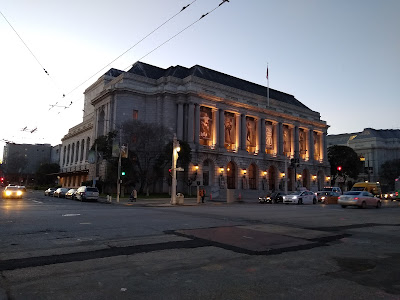
Photo by Lisa Hirsch

It's finally here: the San Francisco Opera centennial season announcement. It's kind of a wow! And that's even though it's a shorter season than I would like; I'm somewhat surprised that with all of the hoopla and fundraising attendant on such an occasion, the company couldn't get donors to pony up enough money for 10 operas. 

To my surprise, the announcement includes part of the 2023-24 season, and that looks like it'll be a good one as well, because it's got three new operas on it.

Here are the answers to the quiz that Matthew Shilvock set up, with as much detail as I can reasonably fit in a bullet list:
  • Two new operas by Bay Area composers
    • John Adams, Antony and Cleopatra, libretto put together by the composer largely from the Shakespeare play, but with additional texts from other sources. Julia Bullock and Gerard Finley as the title characters; also starring Paul Appleby, Alfred Walker, Elizabeth DeShong; directed by Elkhanah Pulitzer. This will be the opening night performance, which I have some doubts about, because having an offbeat work didn't work so well back in the Rosenberg era when one of her seasons opened with The Mother of Us All. Music Director Eun Sun Kim conducts. (Right now I'm thinking that I should try to find a commercial recording or bootleg of the Barber Antony that opened the Metropolitan Opera House at Lincoln Center.)
    • Gabriela Lena Frank, El úlitmo sueño de Frida y Diego, libretto by Nilo Cruz. Co-commission; first performances are at San Diego Opera in October, 2022. Starring Daniela Mack (Frida), Alfredo Daza (Diego), Yaritza Vélez, and Jacob Ingbar star. Roberto Kalb conducts, Lorena Maza directs. SFO has made a great effort here to cast this with native Spanish speakers from the Americas! I think that this is the first main-stage work composed by a woman and the first work in Spanish to be presented by SFO. She is also Jewish, but there's Meyerbeer in the company's past, so she's definitely not the first Jewish composer to have a work in the repertory here.(Whatever happened to those rumors about Florencia en el Amazonas?) 
  • Two new productions from the core repertory
    • Madama Butterfly, co-production with The Tokyo Nikikai Opera Foundation, the Semperoper Dresden and The Royal Danish Opera. There is a concept, which is seeing the opera through the eyes of Dolor, Cio-Cio-San and Pinkerton's son. Directed by Amon Miyamoto  and starring Karah Son and Michael Fabiano. Hyona Kim is Suzuki and Lucas Meachem is Sharpless. Eun Sun Kim conducts. There's an effort here not to engage in yellow face, which is good. There's also a statement about this opera and Asian Opera Alliance. Note the work being done at Boston Lyric Opera's Butterfly Project discussion series, which seems like the kind of thing SFO could do.
    • La Traviata (finally, the 35-year-old Copley production is being replaced). Pretty Yende (Violetta), Jonathan Tetelman (Alfredo), Simone Piazzola (Germont). Shawna Lucey directs, Eun Sun Kim conducts.
  • Two operas that had their US premieres here. YES, these are what I'd hoped for!
    • Die Frau ohne Schatten, R. Strauss, in the David Hockney production. Conducted by Sir Donald Runnicles, of course; with Nina Stemme (Dyer's Wife), Camilla Nylund (Empress), Linda Watson (the Nurse), Johan Reuter (Barak), and David Butt Philip as the Emperor. Nothing about the casting of the Spirit Messenger, Voice of the Falcon, Guardian of the Threshold of the Temple, the brothers, or any of the other gazillion roles in this gigantic work; presumably many of them will be drawn from the ranks of the 2023 Adler fellows because this is during the summer of 2023. Roy Rallo directs. 
    • Dialogs of the Carmelites, Poulenc, production by Olivier Py, from the Théâtre des Champs-Elysées. Heidi Stober as Blanche de la Force,  Michelle Bradley as Madame Lidoine, the new Prioress; Michaela Schuster (Madame de Croissy, the Old Prioress), Melody Moore as Mere Marie, Deanna Breiwick as Sister Constance. Ben Bliss returns as the Chevalier de la Force. Eun Sun Kim conducts. A great opera that hasn't been done here since 1982.
  • Two operas in styles not heard in a number of years 
    • Eugene Onegin, Tchaikovsky, Robert Carsen's production, which is supposed to be very beautiful. Evgenia Muraveva as Tatyana, Gordon Bintner as Onegin, Evan LeRoy Johnson (Lensky), Aigul Akhmetshina (Olga), Ferruccio Furlanetto (Prince Gremin). Vassilis Christopoulos conducts. in his American debut.
    • Orpheus and Eurydice, Gluck, new SFO production. This will be the third production of this opera that I've seen in the last several years.  Matthew Ozawa directs; his Fidelio was superb, so I have high hopes. Jakub Józef Orliński as Orpheus, Christina Gansch as Eurydice, Nicole Heaston as Amor. Peter Whelan from the Irish Baroque Orchestra and Ensemble Marsyas conducts.

The above are all productions new to San Francisco Opera.

For me, the biggest surprise in the above is that there's no production for Nicola Luisotti; I've assumed that there would be one for the former music director in this important season. Oh, well, maybe in 2023-24. But I do wonder whether either Traviata or Butterfly was originally intended for him.

Additionally, there's all of this happening:
  • Opening night concert and Opera Ball, September 9, 2022. Concert with Nadine Sierra, Michael Fabiano, Pene Pati, and Lucas Meachem. Eun Sun Kim conducts.
  • 100th Anniversary Concert, Friday, June 16, 2023. "A historic evening of music and memories." Eun Sun Kim conducts, details to follow.
  • Opera in the Park, Sunday, September 11, 2022 at 1:30 pm, Robin Williams Meadow, Golden Gate Park. Free.
  • Open House, Sunday, October 23, 2022. Tours and lots of family-friendly activities and demonstrations. Free.
  • Boheme Out of the Box, which will take a condensed La Boheme to SF communities.
  • Exhibitions of costumes and photos from the company's history.
Coming in 2023-24: three new operas, all SFO co-commissions, which is amazing for a company with an eight-opera season:
  • Mason Bates, The (R)evolution of Steve Jobs
  • Kaija Saariaho, Innocence
  • Rhiannon Giddens and Michael Abels' Omar
Other items of interest:
Do I have a regret or two about this season? Sure: there's no sign of Karita Mattila or Patricia Racette, both of whom have been stalwarts of the company for many years. (Or Ruth Ann Swenson, who is retired.) Philip Skinner, one of my favorite singers, has only a small role. I'd hoped that if SFO did Frau that it would cast Christine Goerke as the Dyer's Wife; she was wonderful at the Met in 2013. But it's a short season; there are many exciting debuts, and the company is definitely looking very much to the future in its casting.


Friday, March 05, 2021

San Francisco Opera Ring Festival


Ring Festival Trailer
Courtesy of San Francisco Opera

As I mentioned a couple of weeks ago, San Francisco Opera is streaming its 2018 Ring production on consecutive Saturdays this month, with each opera available until late the day after the stream starts. In addition, there is a fantastic lineup of interviews, panel discussions, and lectures. You can see the full schedule on the company's calendar.  The Festival kicks off at 1 p.m. today, with Ring director Francesca Zambello, conductor Donald Runnicles, bass-baritone Greer Grimsley and San Francisco Opera General Director Matthew Shilvock talking about the production; you can see Das Rheingold starting tomorrow.

The non-opera events are available live and on demand; you can see individual events for $15 or buy a Festival Pass ($99 for the general population; $69 for SFO donors at $75 or more). There are free passes for high school and college teachers and students as well. Details here.

I am generally opposed to music that starts as soon as you open a web page, but I do kinda wish I could have the Valhalla motive play when you view this post! Absent that, here's an excerpt from a 1951 Ring performance, which you can play or not. The video above is accompanied by....perhaps more generally familiar music from the Ring.


Sunday, July 07, 2019

Goings-On at the Paris Opera


Bastille Opera
February, 2019
Photo by Lisa Hirsch


UPDATE, 7/5/2019:  The COC is denying the report, but the Globe & Mail article is paywalled, so I cannot quote it.

About two months ago,  Definitely the Opera reported on the administrative situation at the Paris Opera (Opéra National de Paris). At the time, the following administrators were under consideration to succeed Stéphane Lissner, who must retire from his post as general director owing to retirement age:
  • Peter de Caluwe (current La Monnaie director) 
  • Dominique Meyer (Wien Staatsoper)
  • Olivier Mantei (Opera-Comique in Paris) 
  • Alexander Neef (Canadian Opera Company; artistic advisor at Santa Fe)
Earlier, Christina Scheppelmann had also been under consideration, but she is succeeding Aidan Lang at Seattle Opera, Lang having accepted the general directorship at the Welsh National Opera.

It now appears that Alexander Neef has been tapped for Paris, which will leave the COC without a director in a couple of years. Lissner's contract will be extended until Neef is able to take over.

This leaves Paris still looking for a music director (or chief conductor, whichever title is correct) to take over from Philippe Jordan, when Jordan departs for Vienna in 2020. 

Here's the thing: after hearing him three times in Paris and reading accounts of his work in the Met Ring, I'm pretty sure that Paris can do better. Of the three I heard him conduct, Bérénice was, at the time and in retrospect, the most impressive. It's a new piece, and, I think, a great one, but what it most called for, and I saw it twice, seems to be extreme precision, rather than sweep or overarching shape.

This is Jordan's metier. Take a look at comments from Christian Van Horn and Brandon Jovanovich in my article Touring the World with Les Troyens; that's a conductor who is perhaps too focussed on the measure-by-measure aspects of a work. I found his pacing and much else in Tristan odd; he seemed to miss the overall structure of the work. As for his Troyens....when I heard Donald Runnicles and Sir Andrew Davis conduct the opera, I was convinced that I was hearing the greatest opera ever written. They gave the work real sweep and power and yes, large-scale structure. Jordan's conducting in the opera was clean, fast (too fast for my taste), and...seemed a little perfunctory. It certainly didn't have the emotional impact that Runnicles and Davis gave it. I don't think this had anything to do with the Tcherniakov production, which I liked a lot, and the singers were uniformly outstanding.

A friend who heard Jordan's Götterdämmerung told me he found it efficient; Joshua Kosman saw the HD broadcast of the Met Die Walküre and questioned something - rhythm and harmonic structure? - about Jordan's conducting. That's in line with what I heard in Paris.

So, also of interest in Paris: who will succeed Jordan?

UPDATE: I found @JoshuaKosman's tweet about that Walküre (and the whole thread is here):


FURTHER UPDATE: I meant to quote Zachary Woolfe on Jordan's conducting in the Met Ring, which matches what I heard in Paris:
If only the orchestra had been nearly so characterful. While Philippe Jordan’s conducting had moment-by-moment fleetness, and agile responsiveness to the singers, there was no sense of long-arching accumulations of intensity, little variety of mood or color. The sound was thin, murky and diffuse, like a cloudy broth; the brasses were inelegant even when not flubbing.

Sunday, September 16, 2018

Runnicles and Luisotti

I did a summing up the other month of Nicola Luisotti's career at San Francisco Opera, but I omitted something I'd consider important: a summary of the composers he performed at SF. Just for the heck of it, I'm including Donald Runnicles for contrast:

Runnicles: 101 productions of operas by Wagner, Rossini, Mussorgsky, R. Strauss, Verdi Beethoven, Mozart, Puccini, Gluck, Susa, Bizet, Wallace, Britten, Debussy, Janacek, Humperdinck, Berlioz, Messiaen, Busoni, Shostakovich, Thompson, Tchaikovski, Adams, J. Strauss, Stravinsky, and Korngold.

Luisotti: 36 productions of operas by Verdi, Puccini, R. Strauss (Salome), Bizet, Wagner (Lohengrin), Boito, Bellini, Tutino (Two Women), Giordano (Andrea Chenier).

Runnicles was here for many more years, including part of the Mansouri era, which featured a lot of Russian opera, and the Rosenberg era, which was the most adventurous ever. Luisotti was here for most of Gockley and the early Shilvock era only, and as we know, David Gockley really wanted to restore endangered Italian opera to its full glory, so a music director whose talents lay 95% in that area was perhaps just right for him.

Still, you can see whose talents are the broader.


Tuesday, June 19, 2018

O heilige Götter!


Closing scene of Die Walküre
Greer Grimsley (Wotan), Iréne Theorin (Brünnhilde)
Photo: Corey Weaver / San Francisco Opera


My review of San Francisco Opera's Der Ring des Nibelungen is now posted at San Francisco Classical Voice. I haven't re-read it yet; I did some editing this morning around 6 a.m. and, as always, I have doubts.

Covering four operas in one review is tough. I took a tack I usually don't, with some comparisons to the 2011 bring up. I think this is reasonable, especially since, overall, the company fielded a much better cast than in 2011. Still, I had to omit so much detail!

In addition, I have some thoughts that really aren't appropriate for a review, though they're fine for a blog post. For this cycle, I decided to sit in my subscription seats up the in Dress Circle, rather than in the Orchestra with the rest of the press corps. This had the advantage of giving me a great view of the stage and better sound than you get from the usual seats, where you can hear the echo off the audience-left wall and from which it is difficult to judge orchestral balances and orchestra/singer balances.

Those were the gains. The loss was in being pretty far from the action versus sitting in the orchestra. Even with binoculars, I felt somewhat removed from the drama, especially since the last time I saw the Ring, I was in about row 6 of the Festspielhaus in Bayreuth. That was intimate, and, yeah, I missed that.

That said, I'm pretty darned happy with what I saw and heard in the opera house. Donald Runnicles has the orchestra playing fabulously well, and there's a lot of terrific singing. I should really have managed an "Iréne Theorin saves the day" statement someplace in my review. It's amazing to me that she could come into this production on a month's notice, arriving after that, and learn the staging so fast, then give such a wonderful performance. San Francisco Opera is very, very lucky that she was available and willing to step in.

It's not too late to get tickets, although they will probably be expensive tickets; the less-expensive seats undoubtedly sold out a while ago. This is a good production, and it would be hard to assemble a better cast and conductor.

Monday, September 26, 2016

SF Opera 2018 Ring Announcement

No time until later for a full discussion and comparison with my predictions, but here are some of the leading roles.

What was known
Conductor: Donald Runnicles
Wotan: Greer Grimsley
Brünnhilde: Evelyn Herlitzius (I was hoping against hope that this would change.)
Loge: Stefan Margita

What wasn't known
Alberich: Falk Struckmann (who was way off my radar for this and who is....a veteran, let's say)
Fricka: Jamie Barton! (one of my guesses)
Siegmund (& Froh): Brandon Jovanovich (one of my guesses)
Sieglinde: KARITA!!!! (I had no idea but I'm happy. Probably you will be too.)
Siegfried: Daniel Brenna
Hunding / Fafner: Raymond Aceto
Gunther (& Donner): Brian Mulligan (Casting that had NOT occurred to me)
Fasolt and Hagen: Andrea Silvestrelli
Mime: David Cangelosi

Saturday, October 24, 2015

Monday, June 29, 2015

Les Troyens: 2.5 and Counting


Back in the fall - this seems a million years ago now - I swapped my Troyens subscription seats from a night assigned to Davida Karanas for Cassandre to one of the nights when Anna Caterina Antonacci was singing. I now wish I had not, what with Karanas leaving the production and Michaela Martens coming in, but I think I was sick or recovering from being sick that Saturday night, and anyway I did get to see Martens at the second performance.

What I did not expect, and neither did anyone else, was that star tenor Bryan Hymel would sing the first two performances, then get sick and miss the third, fourth, and fifth performances. So last Thursday, I heard Corey Bix as Enée. David Gockley came out to announce that Hymel was indisposed, which by then I had known for about two hours anyway, because when I arrived at the opera house I could see the ushers putting the announcement in the programs. Gockley mentioned that the part is "one of the five most difficult" tenor roles as a graceful way to tell us to give Bix the benefit of the doubt. 

As I've noted, there aren't very many active singers who even know this role (I count nine at most), and the ones who do know it mostly have big careers and are not available to cover each other. I suppose if Roberto Alagna were on vacation and SFO asked him to sing a couple of Troyens performances, sure, he might do it, for the glory and the paycheck. But you can't count on a famous singer's availability in this situation. (That 1983 SFO Otello where Placido Domingo flew across country on a private jet, had a police escort from the airport, and the curtain went up at 10 p.m. or something? It was opening night, and saving the day must have been irresistible.)

So yes, I am completely happy to give Bix the benefit of the doubt, and more. I give him major props for a credible performance under difficult circumstances in, yes, one of the most difficult of tenor roles. He has a sizable, hefty, dark-toned tenor; unlike Hymel, he's not a high-note singer and so Enée is not a perfect fit. (Okay, must state clearly: Enée is a perfect fit for WHO, exactly?) He paced himself carefully, a smart thing to do in this situation, and this role, and sounded good in the big duet, which calls on the tenor's lyric capabilities rather than heroic.

It was, overall, an honorable performance, and SFO is lucky to have him on hand.

For those of us who've heard both Hymel and Bix, it's also an object lesson in what makes a star. Bix is a big, tall guy, and yet he didn't present as a heroic figure; Hymel looks like a gods-driven man of action, somehow giving the impression that he is about to run off and found the Roman Empire dash across the stage and into battle when he's standing still with a sword in hand. And Hymel's vocal self-confidence and ability to pop out those high notes make a huge difference in this opera.

At least some of this is teachable; you can learn how to present with self-confidence, or more self-confidence, with various kinds of training, whether martial arts, public speaking, or acting. Bix made what looked like a self-deprecating gesture during the bows, which I took as a modest acknowledgement that he wasn't quite what the audience was hoping for. I think he is going to have a decent career, probably in the regional companies, because there certainly IS a need for reliable singers with good, beefy voices at all levels. And he has sung a few major roles with more visible companies; Bacchus at Glimmerglass, Erik with LA Opera, and so on. So keep an eye on him; maybe he will make the jump to stardom.

As for the rest of the performance, I'm still not entirely happy with Antonacci. Sitting in the dress circle, I could hear her better than in the orchestra, but her voice still seems too lyric, too small, for this role in a huge house. At the end of Act I, for example, Cassandre is obviously supposed to flood the hall with sound, but Antonacci just can't do it. "La prise de Troie" sagged a few times, and I think it might have been because Runnicles had to tone down the orchestra to properly support her without drowning her out. A friend pooh-poohed me when I mentioned her voice size as an issue, saying it's Enée and Didon who are supposed to fill the hall, but look at the great Cassandres of the past 50 years and you see a string of dramatic voices: Crespin, Verrett, Ludwig, Norman. (I have a fantasy that a certain dramatic soprano with a great lower register might be learning the role, and she would be a sensational Cassandre, based on the available evidence, including a known ability to outsing a very large orchestra.)

On the other hand, Susan Graham. Oh, man, she was even better than opening night, really heartbreaking. She cracked a couple of times in the parting scene with Enée, which reinforced what she is putting into the performance. A great, great assumption; I'm lucky to be seeing it.

More to come, because I have a ticket for Troyens no. 6.

Tuesday, November 16, 2004

The Maestro's Birthday Party - What's on the Menu?

Donald Runnicles, music director of the San Francisco Opera, turns 50 and celebrates tonight with a gala all-Wagner concert. The artist list includes Christine Brewer, Willard, White, and three of the leads in the current production of The Flying Dutchman - Juha Uusitalo, Christopher Ventris, and the marvelous Nina Stemme. It's not difficult to hallucinate what they might be singing. Some Tristan from Brewer; maybe Isolde's Narrative and Curse, maybe her Transfiguration. White is a natural for the "Leb'wohl" from Die Walkuere or "O du mein holder Abendstern" from Tannhäuser. For Stemme and Uusitalo, the Act II Dutchman/Senta duet.

But there are two unexpected singers on the roster - Carol Vaness and the great Frederica von Stade. What on earth are they singing? Vaness sings dramatic parts but ought not; perhaps it's Elsa or Eva for her. As for Flicka, there's not a lot of work in Wagner for a lyric mezzo, even a high lyric mezzo. Maybe Magadalena in the Meistersinger quintet? Or the Wesendonck Lieder??