Tuesday, August 27, 2013

Taking the Load off Pat

On the SFO web site:

CAST

MEFISTOFELEILDAR ABDRAZAKOV
MARGHERITAPATRICIA RACETTE
FAUSTRAMÓN VARGAS

In the opening week press release:

Margherita, Elena                Patricia Racette                                      
Elena                                     Marina Harris (9/14, 9/17, 9/29)

Why Not [DeYoung / S. Cooke / Another Mezzo]?

John Marcher asks some questions about why Patricia Racette is stepping is for Dolora Zajick in next months's world premiere of Dolores Claiborne, rather than Michelle DeYoung, Sasha Cooke, or another first-class mezzo-soprano.

Well, here's what I know or have seen mentioned elsewhere:
  • Tobias Picker's first choice for Dolores was reported in Opera News to have been Racette (via Parterre Box).
  • Racette has worked with Picker in two of his previous operas. (h/t JK for the correction here)
  • She's here through October 4.
  • Catherine Cook is said on Parterre Box to have done all of the stage rehearsals to date.
  • Zajick withdrew from participation at the Orange Festival earlier in the summer.
So, an opera company has to make plans. Zajick's withdrawal from the Orange Festival is specifically called out in the SFO press release as having alerted the company to a possible problem. She has a history of knee problems going back a few years. Here's a 2005 Playbill item noting her withdrawal from a production back then.

My speculation: with the possibility of Zajick withdrawing, SFO started considering alternatives. As Picker's first choice for the role, Racette would have been a candidate to take over in any event. Her presence here would have made the logistics easier than otherwise. (Never mind that she's singing two roles in another opera rehearsing and playing simultaneously!) Picker would have started preparing soprano alternatives to the mezzo lines earlier this month some time, and for all we know, Racette has been working on the new role since she arrived in SF for Mefistofele rehearsals.

The thing is, we actually do not know whether SFO tried to engage a star mezzo for this role. They're not going to tell us whether there were negotiations that fell through, or how many singers or management companies they talked to. It's also good to remember that there aren't that many singers willing to jump in on a month's notice to learn demanding new-to-everybody roles and who are logistically able to fit in the rehearsal period and performances.

Monday, August 26, 2013

Joshua Kosman Reminds Us That He Foresaw This Day.

He says he was only joking when he wrote this in a 2001 review of La Traviata:
In what must be an operatic version of the actor's nightmare, Racette found herself surrounded by a cast and production that was almost entirely inadequate to the occasion. 
She didn't flinch. Instead, she offered a superb portrait of the consumptive courtesan Violetta Valery, marked by dramatic cogency and vocal splendor that outshone even her powerhouse turn in the title role of Verdi's "Luisa Miller" last September. 
For that matter, this may be the answer to the Opera's long-standing struggles to give Verdi's work its due in performance: Simply hire Racette for everything.
 Read the whole review here.

Also, for my part, h/t Parterre Box for the pointer to the changes in the SF Opera web site that presaged today's press release.

"Dolora Zajick Withdraws"

Most of the press release is after the jump. I'm so sorry and hope that Ms. Zajick will indeed be back soon.


Did I Say Something About the All-Racette Season a While Back?

Yes, I did.

And now, look at the SF Opera web page for Dolores Claiborne to see why the post title was almost "What. the Fuck." Zajick out entirely, which is worrisome, with Patricia Racette (s) and Catherine Cook (m) swapped in for her.


CAST

DOLORES CLAIBORNEPATRICIA RACETTESEP 18, 22, 25, 28
DOLORES CLAIBORNECATHERINE COOKOCT 1, 4
SELENA ST. GEORGESUSANNAH BILLER
VERA DONOVANELIZABETH FUTRAL
JOE ST. GEORGEWAYNE TIGGES
DETECTIVE THIBODEAUGREG FEDDERLY


SFS Appoints a Principal Percussionist

No official word from SFS about this, but cleveland.com announced last month that the Cleveland Orchestra's principal percussionist, Jacob Nissly, has accepted a job in San Francisco. Presumably this explains why scheduled auditions for a principal percussionist have disappeared from the SFS orchestral auditions page.

Mr. Nissly was a member of the New World Symphony and has been principal percussionist in Cleveland for two years, following a stint at the Detroit Symphony.

H/T Mr. CKDH for the link.

Friday, August 23, 2013

You'll All Hate Me in a Minute.


Or at least doubt my judgment.

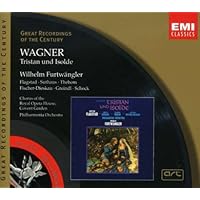
Several NY Times classical music writers, and Alex Ross in response to those writers, have posted lists of favorite Wagner recordings. Not quite universally on the lists is Furtwängler's Tristan und Isolde.

I'm going to have to give it another listen, because that recording heads up a personal list of my own: Most Overrated Recordings of the Century.

I don't care that it's in mono. I care a lot about the fact that its Isolde, the great Kirsten Flagstad, is significantly diminished from even two years before on Furtwängler's La Scala Ring. She is a shadow of what she sounded like in the 1930s.

I don't care about the Cs that Elizabeth Schwarzkopf sang for her (and, IMO, the Bs as well). I do care that Flagstad sounds thick-voiced and matronly, placid and without the kind of subtlety that might make one forget the losses. 

For me, this is what keeps the recording off my list of favorite Wagner recordings. To see why, compare the Flagstad of 1952 with the Flagstad of 1935 (or 1936 or...).

Thursday, August 22, 2013

A Smoking Gun in Minnesota

Emily Hogstad of the blog Song of the Lark has the scoop: In May, 2012, the Minnesota Orchestra Association purchased some domain names that could be used by supporters of the musicians, for two-year terms. That would be five months before the lockout began. Management clearly anticipated that they might be on the verge of actions that would upset the audience.

(H/T Alex Ross, H/T Drew McManus)

Wednesday, August 21, 2013

Style

A periodical I read uses the following styles:
  • For the early 20th century classic by Richard Strauss, "Elektra" 
  • For the title character, in running text, the Anglicized Electra
  • For her mother, Clytemnestra
  • For her sister, Chrysothemis
I note that in my first Lulu, in 1989, Dr. Schön was sung by the great Hans Hotter, who was then 80. It was the only time I saw him live. In my second Lulu, Countess Geschwitz was sung by Frederica von Stade, in her only run in that role. I remember very little about Hotter, but von Stade, regal in a bottle-green velvet dress, was unforgettably vivd.

Moonlight Becomes You

Check out the lovely Google Doodle.

More on Minnesota

Alex Ross has some remarks on Minnesota and links to a speech by Alan Fletcher (President & CEO of the Aspen Festival) to Orchestrate Excellence; there's also a transcript (or copy of the speech) at Slipped Disc.

The latest bad news is that the Swedish record label Bis, which has been issuing the Vänskä/Minnesota Sibelius series, has canceled planned recording sessions for the Third and Sixth symphonies. If the lockout ends and the orchestra has a contract, there's a week in the spring that could work for making the recordings.

I have thoughts, but I'm waiting to see what happens in September, when Vänskä will either stay or go.

Tuesday, August 20, 2013

And No Again.

Dear Spammers,

My, I'm getting more spam comments since I loosened up the authentication requirements for posting comments! The blog is still on moderation, so your spam isn't going anywhere but into dev/null. You might as well just stop it.

Luv,

Lisa

No.


Email received today from San Francisco Opera provided instructions on how to move their promotional emails and newsletter from the Promotional tab in the Gmail inbox to the Primary tab.

Uh, no. The Promotional tab is there to keep my inbox from getting too cluttered up with email from SFO, SFS, the Met, LAPO, SF Performances, Cal Performances, Priceline, BookIt, TravelZoo, Southwest, Noe Valley Chamber Music, a few theater companies, SFRV, SFCV, SF Choral Artists, Shuman Associates, Q2 Music, and goodness knows how many other organizations that send me regular, perhaps too regular, email.

Don't worry about my missing something from you - goodness knows, don't I pester the communications department and box office often enough? - because I check the nonprimary tabs at least daily.

Monday, August 19, 2013

I'm Too Stupid for This One.

Harold Pinter's No Man's Land is this summer's hot Bay Area theater ticket, owing to the presence in the cast of Ian McKellan and Patrick Stewart, not to mention Billy Crudup. McKellan and Stewart are best known in the US for their film and TV work, but they do a lot of stage work in Great Britain and, occasionally, in the US. (I rather suspect that they've each made enough money playing wizards, space captains, and mutants that they can do whatever they damn well please for the rest of their professional lives, and more power to them.)

In any event, we scored tickets by virtue of being included in a large group ticket purchase, and we saw the show Saturday night. At the end of it, about all we could say was WTF? Because the acting is stupendous (McKellan and Stewart are both subtle and convincing actors; Crudup is excellent but seems wasted in a small role), but WTF? Plot? What happened? Why? How come the audience kept laughing at things that were not funny?

It's not even a matter of having an unreliable narrator or character. In this case, the playwright is unreliable.

Is the rest of Pinter's body of work like this? If so, I will be thinking twice about ever seeing one of his plays again.

No Comment

Found on IMDB:


Minnesota Orchestra on the Brink

Osmo Vanska, music director of the Minnesota Orchestra, has stated that he will resign on September 9 if the musician lockout isn't resolved; reports (on Lebrecht, though) say that the board doesn't care about this.

If true, that says it all: a board that doesn't care about retaining a great conductor just doesn't give a damn.

Also at Lebrecht, commenters saying "but the orchestra just doesn't have the money to pay the musicians what they want." YES THEY DO. The orchestra has a substantial endowment ($140 million) and this very board, the one that can't find money for salaries, was able to raise around $45 million for renovations to the orchestra's concert hall.

As always, Bill Eddins has a few useful things to say. So does Drew McManus.

Sunday, August 18, 2013

The Cabrillo Audience

Over at San Francisco Classical Voice, David Bratman reviewed a recent Cabrillo Festival program and someone gave him a hard time about the review itself. (This is not the review where he called Magnus Lindberg a modernist, a term under discussion elsewhere on this blog.) It is likely I would respond to the program somewhat differently from David, but I found "GG12"'s objections incomprehensible, though my response didn't exactly say that.

Joshua Kosman reviewed Cabrillo programs that included Rouse, Friar, Newman, and Puts, with the big pieces being the West Coast premier of Chrisopher Rouse's Symphony No. 3 and the world premier of Kevin Puts's Flute Concerto. He loved the Rouse, but found the Puts disappointing.

Yesterday, the Chron published a long letter from the commissioners of the Puts concerto, Joseph and Bette Hirsch (NO RELATION, I repeat, no relation). Their main point is "everybody loved it but you, and you should have told readers about the standing ovation."

Look, almost every concert at Cabrillo gets a standing ovation. That is a meaningless metric. I have sat through standing o's for plenty of pieces I didn't much care for myself, like, uh, Philip Glass's Tenth. And of course people told the commissioners what a wonderful piece it was! What else are they going to say?? "Too bad it's crap" is not what a reasonably civilized person will say to folks who have just dropped thousands on a commission.

As for the other point, sure, Joshua could have noted that lots of people loved the concerto. It would make for more complete reportage on the program, which is one of a reviewer's charges. But based on what I've heard of Kevin Puts's music, I suspect I would have been with Joshua on the merits.

NB: SFCV's Jeff Dunn had some doubts but mostly sided with the audience on the Puts.

Thursday, August 15, 2013

Carter is Still Dead....

...and the Tumblr Fuck Yeah! Elliott Carter gives Daniel Asia's remarks about Carter the shredding they so richly deserve.

The Blog Conversation

I appear to have discovered how to get conversations going:
  • Post about Peter Singer.
  • Post about [subject of musical controversy].
  • Loosen up Blogger's comment settings a little.
I've got 12 comments on one posting, 14 on another. I can't complain.

Also, blogger/science fiction fan Paul Krugman has a few words on the value of the econoblogosphere. The music blogosphere can be a check on the errors and omissions of.....NY Times reviewers!

Changes to Commenting

I've made some changes to commenting in response to issues several readers have reported to me. This should make things easier in the areas of authentication and real-person verification. The blog is still on moderation, and let's just say that I discourage anonymous comments. If the anonymous option is the only one that works for you, please include your name in the posting itself.

Problems Posting Comments?

A friend reports browser errors - from three different browsers - when he tries to post comments. Is anyone else having similar issues? If so, please email me (lhirsch@gmail.com) with details.

The usual troubleshooting strategies are restart the browser, restart the computer, make sure Java and Flash are up to date (darned if I can recall which you need for posting to Blogger), and make sure you are signed in to the correct account for posting comments.

Definition of Modernism / Modernist in Concert Music


There's some discussion on David Bratman's recent SFCV Cabrillo review of the term "modernist," after David called Magnus Lindberg a modernist. I dunno, I can't make that fit, largely because I think of modernists as composers who use rigorous formal compositional organizing techniques, or something like that. Serialists, and non-serialists such as Carter, are who I think of as modernists, or at least "high modernists," when it comes to, say, Boulez, Babbitt, Carter, etc. Lindberg certainly isn't in that camp.

Please discuss; all comments welcome.

Cabrillo Review

Enrico Chapela caricature, from the composer's web site


My latest review is of last Saturday's "Unstuck" program at Cabrillo. I referred to this festival the other week as the Cabrillo Festival of Middle-of-the-Road Contemporary Music, but maybe I just get to the wrong concerts: the Kronos program was obviously more challenging and experimental than the last several concerts I've heard there. But if you look back at what Cabrillo used to perform, whole swaths of contemporary and recent music are missing. I dunno, I wish they performed a broader range of styles, but it's also true that they're selling tickets, have a good donor base, and of course put on superb performances.

Wednesday, August 14, 2013

"Good Charity, Bad Charity"?

In Sunday's NY Times, the Princeton bioethicist Peter Singer continued his narrow-minded assault on most types of charitable donations. He sets up what I'd consider to be a false dichotomy, contrasting the good done by a charitable donation to a health-related cause to the good you aren't doing by donating to an art museum. He purports to demonstrate that donations to an art museum are bad through the following thought experiment:
Suppose the new museum wing will cost $50 million, and over the 50 years of its expected usefulness, one million people will enjoy seeing it each year, for a total of 50 million enhanced museum visits. Since you would contribute 1/500th of the cost, you could claim credit for the enhanced aesthetic experiences of 100,000 visitors. How does that compare with saving 1,000 people from 15 years of blindness? 
To answer, try a thought experiment. Suppose you have a choice between visiting the art museum, including its new wing, or going to see the museum without visiting the new wing. Naturally, you would prefer to see it with the new wing. But now imagine that an evil demon declares that out of every 100 people who see the new wing, he will choose one, at random, and inflict 15 years of blindness on that person. Would you still visit the new wing? You’d have to be nuts. Even if the evil demon blinded only one person in every 1,000, in my judgment, and I bet in yours, seeing the new wing still would not be worth the risk.
Let me just say that this is bullshit: there is no evil demon and I don't have to make choices about my charitable donations based on this thought experiment. I'm not accepting his premise, in other words.

I was actually enraged by the op-ed piece, and sent the Times a fairly level-headed letter explaining why. They haven't printed it among the responses to Singer, so here it is:
Peter Singer compares charitable giving to heal victims of trachoma to charity to support an art museum. His comparison is certainly interesting, but why do we have to make these choices? Our failure to provide adequate health care to all in need is a structural problem best solved by governments, not individuals or even foundations and NGOs. Mr. Singer doesn't address this point. 
Moreover, if everyone who currently gives to the arts switched to giving to health charities, our museums, orchestras, and dance companies would collapse. Does Mr. Singer want a world of privatized art, without these institutions? Does he want to deny access to the arts to the general public? 
Giving to the arts isn't bad charity. It does different good from giving to health charities.
For the record, I'm not at all opposed to giving to health-related charities. I give to them myself, and I give quite a bit more money to charities that feed people than to arts organizations. But Peter Singer should just stop trying to guilt-trip people into giving up their support for the arts. I don't want to live in that kind of a society. Does he?

Orchestral Executive Compensation

Adaptistration's annual compensation review reports started coming out today. These are based on the 2010-11 season, the most recent for which 990 tax forms are available.

The first report, on executive compensation, has a few doozies in it:

  • In third place, with compensation just north of $770,000, is the Toledo Symphony. You read that right: not one of the 800-pound gorillas, but an orchestra with an annual budget that is under $7 million. Apparently, that compensation includes a large one-time payment to the exiting long-time CEO.
  • Alison Vulgamore of the Philadelphia Orchestra, who led that august group into bankruptcy, rates a salary around 50% above those of Mark Volpe of the BSO and Brent Assink of the SFS. Note: those two executives have greatly increased their orchestras' endowments at a very tough time. Who do you think deserves the big bucks here?
  • The Los Angeles Philharmonic is another group that's in great shape - and it has an enormous budget - but you still have to wonder how Deborah Borda rates a salary three times those of Volpe and Assink.
  • Zarin Mehta of the NYPO is in between Borda and Volpe/Assink. Okay, NY is a very expensive city. Still, lotta money.